

Key takeaways
- Compare the best vented electric clothes dryers with moisture sensors, from a 7.8 cu. ft. GE with WiFi to a 120V compact, with key specs and buying advice.
A vented electric dryer still dries faster and handles heavy loads better than most ventless designs, because it pushes hot, damp air straight outside instead of recirculating it. Pair that airflow with a real moisture sensor and you get the other half of good drying: the cycle ends when the load is actually dry, not when a timer guesses it might be. Sensor cycles protect fabrics from needless heat, cut wasted run time on small loads, and stop the familiar routine of pulling out a load that is somehow both scorched at the edges and damp in the middle.


This guide covers five vented electric dryers that all use true moisture sensing rather than timed drying alone. The lineup runs from a 7.8 cu. ft. front loader built for family laundry down to a compact 120V model for apartments, and every pick below is a complete dryer, not a part or accessory. Selections are based on manufacturer specifications and current listing data, with attention to drum size, venting flexibility, sensor systems, controls and the extras that matter once the machine is installed.
As an Amazon Associate, we earn from qualifying purchases.
Quick answer
The GE GFD55ESSNWW is the top pick for most homes: a 7.8 cu. ft. vented electric dryer whose HE Sensor Dry tracks moisture and ends the cycle on time, with WiFi, a sanitize cycle and a vent sensor that warns about blockages. Samsung’s Bespoke dryer suits smart-home fans, while the BLACK+DECKER BCED26 covers small spaces on a standard outlet.
1. GE GFD55ESSNWW — best overall
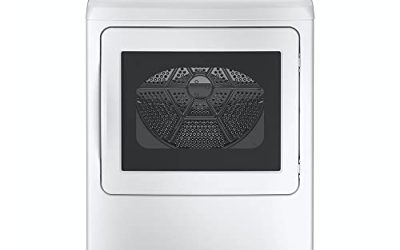
GE’s front load dryer earns the top spot by combining the largest drum in this guide with one of the most complete sensor packages. Its HE Sensor Dry system monitors moisture inside the drum and adjusts the cycle so loads finish at the dryness level you selected, and a separate vent sensor watches the exhaust path and flags blockages that would otherwise stretch drying times and strain the machine. That pairing is exactly what a vented dryer needs, because sensor accuracy only helps when airflow stays strong.
The 7.8 cu. ft. stainless steel drum swallows comforters and full family loads, and the cycle set covers the practical bases: a sanitize cycle for bedding and towels, a quick dry for small loads, wrinkle care that keeps tumbling after the cycle, and a damp alert that signals when garments are dry enough to iron. Built-in WiFi lets you check cycle status from a phone and works with common voice assistants. The door is reversible, the controls are front-mounted, and the cabinet is a full-size 28 inches wide, so measure your laundry space and doorways before ordering.
Key specs
- Capacity: 7.8 cu. ft., front load
- Sensing: HE Sensor Dry moisture sensing, plus Vent Sensor blockage alerts
- Venting: vented electric, reversible door
- Drum: stainless steel
- Controls: built-in WiFi with app and voice assistant support
- Extras: Sanitize cycle, Quick Dry, Wrinkle Care, Damp Alert
2. Samsung Bespoke DVE53BB8700V — best smart dryer
Samsung’s Bespoke dryer is the pick for households that run laundry through an app. Its AI Optimal Dry system reads moisture and temperature in the drum and fine-tunes each cycle, while the AI Smart Dial learns the cycles you use most and surfaces them first. Through SmartThings you can monitor a running load, get an alert when it finishes, and pair the dryer with a matching Samsung washer so the right dry cycle is suggested automatically.
Capacity is 7.6 cu. ft., close behind the GE, and the feature list leans into fabric care: Steam Sanitize+ works steam into a high-heat cycle for bedding and stuffed toys, Sensor Dry cycles cover everyday loads, and Super Speed Dry is built for small loads that need to be ready quickly. The brushed black finish and flat front panel give it a more furniture-like look than most laundry appliances, and the door reverses for tight rooms. If you do not plan to use the app features, the GE above delivers similar core drying for a simpler control experience; if your home already runs on SmartThings, this is the natural fit.
Key specs
- Capacity: 7.6 cu. ft., front load
- Sensing: AI Optimal Dry with moisture and temperature sensing
- Venting: vented electric, reversible door
- Controls: AI Smart Dial, WiFi with SmartThings app
- Extras: Super Speed Dry, Steam Sanitize+, downloadable cycles
- Finish: brushed black
3. GE Profile GTD48EASWWB — best for top-load laundry pairs

Not every laundry room is built around front loaders. This GE Profile model uses the classic top-load-matching layout, with rear controls and a 7.2 cu. ft. aluminized alloy drum sized to sit beside a top-load washer. Its Auto Dry system senses moisture in the load and ends the cycle at the dryness level you pick, which puts it ahead of basic timed dryers that share this shape and control style.
Two practical touches stand out. Extended Tumble keeps the drum turning without heat after the cycle ends, so a finished load does not sit in a creased pile while you are busy elsewhere. The venting system is rated for runs up to 120 feet, which matters in homes where the dryer sits far from an exterior wall, in a basement, or at the end of a long duct path. Controls are simple dials and buttons rather than a touchscreen, the door reverses, and dryness levels and temperature settings cover everyday fabrics without menu digging. Shoppers who want WiFi or steam should look at the two models above; shoppers who want a straightforward sensor dryer that matches a top-load washer will find this one easy to live with.
Key specs
- Capacity: 7.2 cu. ft., top-load matching design
- Sensing: Auto Dry moisture sensing with selectable dryness levels
- Venting: vented electric, rated for runs up to 120 feet
- Drum: aluminized alloy
- Controls: rear panel dials and buttons
- Extras: Extended Tumble, reversible door
4. Midea MLTE37N1BWW — best budget full-size dryer

Midea’s full-size dryer covers the essentials at the value end of this guide. Six of its twelve cycles are Sensor Dry programs — Normal, Delicates, Casual, Towels, Sanitize and Heavy Duty — and they use the dryer’s moisture sensing to stop the cycle when clothes reach the selected dryness instead of running a fixed time. The other six are manual timed cycles, including a quick dry and an air fluff for refreshing garments without heat.
The 6.7 cu. ft. aluminized alloy drum handles family-size loads and bulky items, and installation is more flexible than most: the vent can exit from the rear, bottom or side, and the door reverses, which helps in narrow laundry closets where the duct and the door swing compete for the same space. Wrinkle Care adds unheated tumbling at the end of a cycle to limit creasing. Controls are a simple knob with LED status indicators, and the machine runs on the usual 240V dryer circuit. You give up WiFi, steam and a stainless drum compared with the picks above, but the core job — vented drying that stops when the load is dry — is fully covered.
Key specs
- Capacity: 6.7 cu. ft., front load
- Sensing: Sensor Dry moisture detection on six cycles
- Venting: vented electric, 3-way venting (rear, bottom, side)
- Drum: aluminized alloy steel
- Controls: knob with LED cycle status indicators
- Extras: Wrinkle Care, Sanitize cycle, reversible door, 240V
5. BLACK+DECKER BCED26 — best compact for small spaces
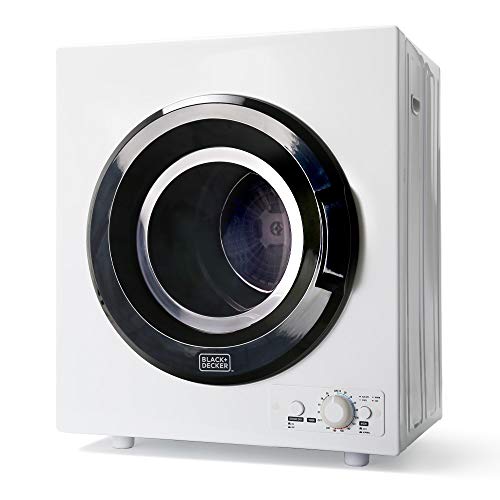
The BCED26 solves a different problem: adding a real dryer where no 240V circuit and no full-size laundry room exist. It runs on a standard 120V outlet, measures under 24 inches wide and less than 18 inches deep, and weighs under 50 pounds, so it fits in apartments, RVs and laundry closets that cannot take a conventional machine. Despite the size, it is a true vented dryer with an exhaust connector in the box, and its Sensor Dry function measures moisture in the load and adjusts the heat rather than relying only on its timer.
The 2.65 cu. ft. stainless steel drum takes loads up to about 8.8 pounds, which means a few outfits or a set of towels rather than a week of family laundry. Five modes cover Air Dry, Cool, ECO, Warm and Hot; ECO mode opens with cool air and brings in heat only as needed. A double-layer lint filter, overheat protection and a transparent door window round out a sensible spec sheet. Cycle times on 120V power run longer than on a full-size 240V dryer, so treat this as a small-load machine and it will serve well.
Key specs
- Capacity: 2.65 cu. ft., loads up to about 8.8 lb
- Sensing: Sensor Dry measures moisture and adjusts heat
- Venting: vented electric, exhaust connector included
- Power: 120V standard outlet, 1400W
- Size: 23.6 x 17.1 x 27.5 in, about 48 lb
- Extras: ECO mode, stainless steel drum, double-layer lint filter
How to choose
Begin with capacity and layout. Households drying comforters and large mixed loads should look at 7.2 cu. ft. and up; smaller households can save space and money with a mid-size drum. Front load models stack and usually carry the richest feature sets, while top-load-matching models suit existing top-load washers and rear-control laundry rows.
Next, confirm the vent path before you fall for any feature list. Measure the run from the dryer to the outside, count the elbows, and check the manufacturer’s maximum vent length; long or bendy ducts slow drying and can confuse moisture sensors. If your run is unusually long, the GE Profile’s 120-foot venting rating is a genuine advantage. Rigid metal ducting keeps airflow strong and lint from building up in ridges.
Then check the electrical supply. Full-size electric dryers need a 240V, 30-amp circuit and a cord matched to your outlet; compact 120V models like the BLACK+DECKER trade speed for plug-anywhere convenience. Finally, weigh the extras honestly: WiFi alerts are useful in a big house, vent blockage sensors protect performance over time, and steam cycles help with bedding, but none of them substitute for a clear duct and a working moisture sensor.
Who should skip
Skip this entire category if your home has no way to vent a dryer outside; a ventless condenser or heat pump model is the right tool there, and running a vented dryer into a room adds moisture and lint you do not want. Renters who cannot modify ducting or add a 240V circuit should also look elsewhere, unless the compact 120V pick fits their lease and a window vent arrangement is allowed.
Skip the full-size models if your laundry space is a shallow closet, and skip the compact if you routinely dry bedding or large loads, since small drums turn big laundry into many slow cycles. Anyone replacing a gas dryer who wants to keep the gas hookup should shop gas models instead, and anyone chasing the lowest possible energy use per load will be better served by a heat pump dryer, accepting its longer cycle times.
Frequently Asked Questions
How does a moisture sensor know when clothes are dry?
Metal sensor bars inside the drum touch the tumbling load and measure how much moisture the fabrics still hold. The control board reads those signals through the cycle and ends it when the load reaches the dryness level you selected, which is why sensor cycles vary in length from load to load.
Can a vented electric dryer be used without venting it outside?
It should not be. Vented dryers are built to push hot air, moisture and lint out through a duct, and running one into a living space raises indoor humidity and spreads fine lint. If no outside vent is possible, choose a ventless model designed for that job instead of improvising with a vented one.
What power supply do these dryers need?
Full-size electric dryers in this guide run on a 240V, 30-amp circuit with a three- or four-prong cord matched to the outlet in your laundry room. The compact BLACK+DECKER is the exception: it plugs into a standard 120V household outlet, which is why its loads are smaller and its cycles run longer.
Why do sensor cycles sometimes leave a load slightly damp?
Mixed loads are the usual cause: thick items hold moisture after thin ones are dry, so the sensor averages a load that is not uniform. Overloading, a clogged lint screen, dirty sensor bars and a restricted vent can also throw readings off. Clean the sensor bars with a soft cloth, keep the duct clear, and sort heavy items together.
Final verdict
For most buyers, the GE GFD55ESSNWW is the vented electric dryer to get: the biggest drum here, moisture sensing paired with a vent blockage sensor, and smart controls that stay out of the way. Choose the Samsung Bespoke if app control and steam fabric care top your list, the GE Profile if your laundry pairs with a top-load washer or your vent run is long, and the Midea if you want full-size sensor drying at the value end. Apartment dwellers are covered too, with the BLACK+DECKER BCED26 bringing genuine moisture sensing to a standard outlet.
Product and ASIN Reference
| Product | ASIN |
|---|---|
| GE GFD55ESSNWW 7.8 cu. ft. Electric Dryer | B086H19LPP |
| Samsung Bespoke DVE53BB8700V Electric Dryer | B0CKNCNN3C |
| GE Profile GTD48EASWWB Electric Dryer | B0DJVK471F |
| Midea MLTE37N1BWW Electric Dryer | B0C7CL53CS |
| BLACK+DECKER BCED26 Compact Dryer | B082YHL9LF |
More from Amazon
Programs that pair well with the guide above. Offers and eligibility are set by Amazon and may change.
Free shipping on eligible items, Prime Video and more. Eligible new members can start with a free trial.
Start a Prime free trialAudiobooks and podcasts to listen to on the go. Eligible new members can start with a free trial.
Try Audible freeAd-free music streaming. Eligible new subscribers can start with a free trial.
Try Music Unlimited freeA free business account with business pricing and bulk-buying tools for work, shop or home office.
Create a business accountAs an Amazon Associate we earn from qualifying purchases.
Write Your Review
No reviews yet. Be the first to share your experience!