

Key takeaways
- Compare heated garment drying cabinets tall enough for business suits, with hanging height, heat, timer and safety checks drawn from Amazon listings today.
A business suit cannot be tumbled, wrung or draped over a hot radiator without risking its shoulders, lining and creases, so the real decision here is not raw drying speed. It is whether a heated cabinet lets jackets and trousers hang at full length in moving warm air, at a temperature gentle enough for wool and structured tailoring, and then shuts itself off when the cycle ends.
This guide is for office workers rotating a small suit wardrobe at home, staff in small firms that keep spare suits on site, and anyone in a rental or dorm where a plumbed tumble dryer is not an option. Every product below was chosen from its name and specifications on its Amazon listing, and only cabinet-style heated dryers that hang garments under a cover qualified.
Quick Picks
As an Amazon Associate we earn from qualifying purchases.
| Product | Best for | Key spec from title |
|---|---|---|
| KASYDoFF Portable Clothes Dryer, 110V -1600W Portable Dryer for Apartment, 67Inch -3 Tier Foldable Clothes Dryers Rack | Suit rotations that need full hanging height for jackets and trousers | 1600W with a 67-inch 3-tier frame |
| COSTWAY Portable Clothes Dryer, Ventless Laundry Dryer, Hot Drying Machine with Heater for Home & Dorms | A single suit or a few shirts in a small room with no vent run | Ventless hot drying machine with heater |
How to Choose
Hanging height comes before capacity
A cabinet can advertise a generous load weight and still be useless for tailoring if a jacket on its hanger brushes the heater housing at the base. Measure the drop you actually need: a suit jacket on a standard hanger needs roughly forty inches of clear hanging space, and trousers hung by the waistband or folded over a bar need more. Compare that figure with the interior height in the listing, not the headline capacity. The taller cabinet in this guide stands sixty-seven inches, which leaves room for trousers to hang straighter, while the fifty-six-inch model suits jackets and shirts far better than full-length garments.
Heat level and how it reaches the fabric
Cabinet dryers push heated air upward through hanging clothes rather than tumbling them, and that distinction matters for wool blends, linings and shoulder padding. Look at the rated power and any stated inner temperature on the listing, then think about what you will load. A higher-wattage unit shortens the cycle for a full rail of damp tailoring, while a lower-powered ventless model works more slowly and gently on one or two pieces. Neither approach presses a crease or steams a lapel, so treat these machines as drying tools that prepare a suit for a brush, a steam or a press, not as replacements for them.
Timer control and automatic shut-off
Leaving a heater running beside fabric is a poor plan, so the timer is a working feature rather than a convenience extra. Prefer a cabinet whose listing states a timed range you can match to the load, such as shorter runs for shirts and longer ones for lined jackets, with the heater switching off at the end of the setting. A wide range, for example thirty to one hundred and eighty minutes, lets a small office dry one suit in the morning without the machine sitting energized all day. Check whether the dial or control is mechanical or electronic, because that affects how precisely you can repeat a cycle that worked well.
Venting, footprint and where the moisture goes
Warm air that dries a suit carries that moisture somewhere, and the two designs here handle it differently. A ventless cabinet releases humid air into the room, which suits a ventilated office or utility space but can leave a small closed room feeling damp after a long cycle. A covered frame with a zip front contains splashes and dust while it runs, yet it still needs clearance around the heater base. Measure the floor footprint from the listing dimensions, confirm a nearby outlet so the cord is not stretched across a walkway, and plan where the folded frame will live between uses.
Safety Notes for Heated Drying
Any appliance that combines an electric heater, fabric and an enclosed cover deserves a careful setup. Place the cabinet on a flat, hard floor with the clearance the manual specifies, keep the cover and hanging garments away from direct contact with the heater outlet, and never leave a cycle running unattended in a locked, empty building. Plug the unit directly into a wall outlet rather than a lightweight extension lead, because the higher-wattage model here draws substantial current on a standard circuit. Stop using the machine if the cord, plug or cover is damaged, and let garments cool before handling them closely. The KASYDoFF listing states a UL specification in its product details; the COSTWAY listing reviewed for this guide states no equivalent certification, so check its product page and manual directly if a specific certification is required for your workplace.
The 2 Best Options
KASYDoFF Portable Clothes Dryer, 110V -1600W Portable Dryer for Apartment, 67Inch -3 Tier Foldable Clothes Dryers Rack, Energy Saving Portable Dryer for Indoor, Travel, RV
This is the pick for anyone whose problem is vertical space, because the sixty-seven-inch frame is the one dimension in this guide that comfortably swallows a jacket and a pair of trousers on hangers without folding either over a rail. The three-tier layout separates suits from shirts, the zip-up cloth cover keeps dust off while warm air circulates, and the frame folds away when the office or spare room has to go back to its day job. It fits a small team wardrobe or one person’s weekly rotation far better than a compact single-rail cabinet.
Specs
- Brand: KASYDoFF
- Model name and model number: V3T
- Power from listing title: 1600W, 110V
- Capacity: 35 pounds
- Item dimensions: 20″D x 28″W x 67″H
- Form factor: Front Load
- Included components: Cloth Cover, Clothes Hanger, Plastic Support, Portable Dryer, Stainless Steel Pipe
- Specification met, as stated on the listing: UL
Best for: Rotating several suits and shirts at home or in a small office, where full hanging height matters more than a tiny footprint.
Watch out for: The listing appears under more than one ASIN and color variant, so confirm the 110V version, the 67-inch frame and the V3T model name on the exact variant before ordering.
ASIN: B0F2H1XNDC
COSTWAY Portable Clothes Dryer, Ventless Laundry Dryer, Hot Drying Machine with Heater for Home & Dorms
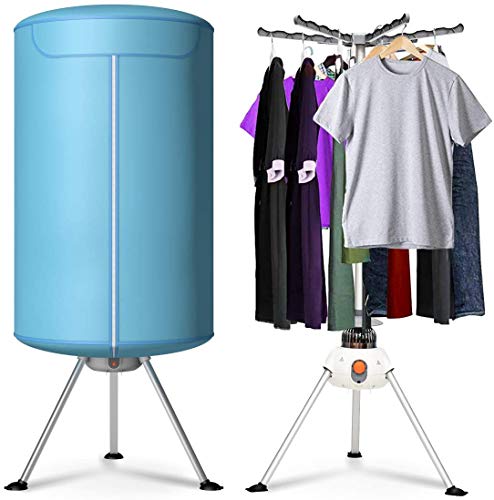
Choose this cabinet when the load is modest and the room has no practical way to vent a conventional dryer. Its fifty-six-inch covered frame hangs a jacket and a couple of shirts, the hot air pump works on a timer you set between thirty and one hundred and eighty minutes, and the whole unit weighs under seven pounds, so it can move between a stockroom, a rental flat and a dorm room without drama. It is a gentler, slower answer than the taller machine above, and that trade suits single suits and small weekly loads rather than a full staff wardrobe.
Specs
- Brand: COSTWAY
- Model info and item model number: 23597-CYEP
- Product dimensions: 27.5 x 27.5 x 56 inches
- Capacity: 22 pounds
- Item weight: 6.78 pounds
- Rated power from listing details: 900W
- Rated voltage from listing details: 110-120V
- Timer range from listing details: 30 to 180 minutes
- Form factor: Freestanding
Best for: Drying one suit or a few shirts in a small, unvented room where the dryer must pack away afterwards.
Watch out for: At fifty-six inches tall it is short for trousers hung at full length, so check your longest garment against the interior height, and note that the listing states no safety certification.
ASIN: B08B7YNGTP
Which One Fits Your Situation
You rotate three or four suits through the week
Pick the KASYDoFF. Its sixty-seven-inch frame and thirty-five-pound capacity let jackets and trousers hang together at full length, and the three tiers keep a damp suit away from dry ones waiting their turn. The cover also means the rail can stand in a spare room without the tailoring gathering dust between wears.
You keep one spare suit at a small workplace
The COSTWAY is the proportionate choice here. A single suit after a rainy commute is a light load, its timer handles the cycle without supervision beyond normal care, and the light frame stores flat or in a corner once the suit is dry. You give up hanging height, so hang trousers folded over the rail rather than at full drop.
Your room has no vent and limited floor space
Start with the COSTWAY, because ventless operation is its whole design and its footprint is a single square of floor. Open a window or run the room’s ventilation during longer cycles, since the moisture from the garments ends up in the room air. If the load grows beyond a few pieces, the KASYDoFF’s covered frame becomes the better answer despite needing more floor.
Your trousers and coats are long
Length decides this one, so choose the KASYDoFF and its taller frame. Trousers that puddle onto the base of a short cabinet dry unevenly and pick up creases exactly where you do not want them. Measure your longest hanging garment first; if it clears fifty-six inches with room to spare, the smaller machine remains an option, and if it does not, the decision is already made.
Common Mistakes
- Buying on load weight alone and never checking interior hanging height against a jacket and trousers on their hangers.
- Expecting a drying cabinet to press or steam a suit, when its job is only to remove moisture from hanging garments.
- Running a ventless cabinet for hours in a small sealed room and ignoring the humidity it releases into the air.
- Plugging a high-wattage dryer into a thin extension lead or a crowded power strip instead of a wall outlet.
- Loading tailored pieces while they are soaking wet, instead of letting heavy water drain off first as the garment care label directs.
Frequently Asked Questions
Can a heated drying cabinet damage a wool suit?
Heat and tumbling are the usual enemies of tailoring, and a cabinet avoids the tumbling entirely by drying garments on hangers. Risk still depends on temperature and time, so use the shortest cycle that dries the suit, keep garments off the heater outlet, and follow the suit maker’s care label over any general advice, especially for lined or fused jackets.
Will a suit fit inside a fifty-six-inch cabinet?
A jacket on a hanger usually fits, because most jackets need well under fifty inches of drop. Trousers are the tight squeeze: hung from the waistband they can reach close to the full interior height. Fold them over a hanger bar instead, or choose the sixty-seven-inch cabinet if most of your tailoring is long.
Do these cabinets replace ironing or steaming?
No. Drying on a hanger lets gravity ease out some creasing while moisture leaves the fabric, which is why hanging drying is kinder than a tumble drum. A suit that went in crumpled will still need a brush, a steam or a press afterwards. Think of the cabinet as the drying step that happens before finishing, not instead of it.
Where does the water go in a ventless model?
It evaporates into the room. The heated air inside the cover picks up moisture from the garments and releases it as humid air, so the room itself becomes the vent. That is workable in a ventilated office or utility room and less welcome in a tiny sealed space, where a long cycle can leave walls and windows feeling damp.
More from Amazon
Programs that pair well with the guide above. Offers and eligibility are set by Amazon and may change.
Free shipping on eligible items, Prime Video and more. Eligible new members can start with a free trial.
Start a Prime free trialAudiobooks and podcasts to listen to on the go. Eligible new members can start with a free trial.
Try Audible freeAd-free music streaming. Eligible new subscribers can start with a free trial.
Try Music Unlimited freeA free business account with business pricing and bulk-buying tools for work, shop or home office.
Create a business accountAs an Amazon Associate we earn from qualifying purchases.
Write Your Review
No reviews yet. Be the first to share your experience!