

For general yard and garden hauling, a four-wheel steel utility cart with removable sides, such as the Gorilla Carts 800 or 1,000 pound models, suits most owners who move bags, pots, lumber and firewood, while a poly yard cart suits people who mostly move loose material and want a rust-free bed, and a big-wheel cart suits hilly or soft ground. The comparison below uses the specifications the makers publish for current models and notes where reviewers and retailer listings disagree, so you can decide on capacity, bed type and wheel style before you buy.
Our top picks


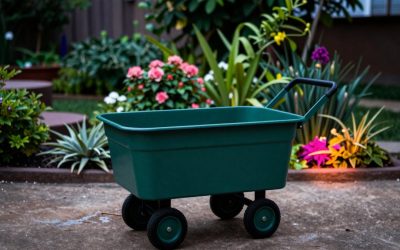
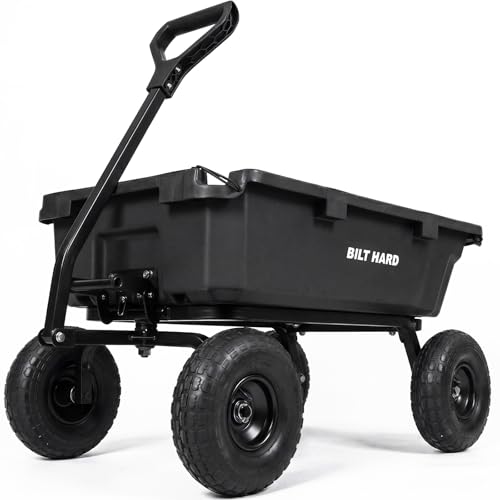 BILT HARD 900 lbs Poly Garden Dump
- All‑Terrain Pneumatic Tires: Equipped with 10‑inch pneumatic tires,…
- Flexible Capacity Expansion: Featuring innovative side expansion slots,…
- Heavy-Duty Construction: Built with a spacious, heavy-duty poly…

As an Amazon Associate we earn from qualifying purchases at no extra cost to you.
Garden utility carts at a glance
| Cart | Best for | Key stated specs | Limits |
|---|---|---|---|
| Gorilla Carts 1,000 lb steel utility cart | Heavy mixed hauling, long items, firewood | The maker lists a 1,000 lb load, steel bed about 49 by 24.5 inches, removable sides, 13-inch pneumatic tires, 2-in-1 tow handle, roughly 60 lb | Flatbed, so loose material must be shoveled out; heavy to lift |
| Gorilla Carts 800 lb steel utility cart | Typical homeowner loads | The maker lists an 800 lb load with removable sides; roundups report a 4 cu ft steel bed | Smaller bed than the 1,000 lb model |
| Gorilla Carts 400 and 600 lb steel utility carts | Lighter, easier-to-store carts | The maker lists these as separate steel utility models | Lower ratings; read the exact model sheet for size |
| Gorilla poly yard carts (4.5 to 10 cu ft) | Leaves, mulch, compost, light stone | The maker lists poly beds in several volumes | Poly flexes and dents; no flat deck for long items |
| Rubbermaid Commercial Big Wheel cart | Slopes, soft lawn, rough ground | The maker lists 300 lb load, two 20-inch wheels, one-piece high-density polyethylene tub, about 45 lb | Lower capacity; two-wheel balance |
| BILT HARD, VEVOR and VIVOHOME mesh or steel carts | Budget buyers | Roundups report ratings from about 400 to 900 lb depending on model | Shorter track records; specs differ between listings |
What a utility cart does that a dump cart does not
A garden utility cart is a general carrier. Its flat or shallow bed accepts items that would not fit a tub, such as fence panels, lumber, bales, bagged soil, potted shrubs and firewood stacks. Many models have removable or fold-down side panels, so the same cart works as a basket for loose items and as a flatbed for long ones. The compromise is unloading. A flat steel deck does not tip, so loose soil or gravel must be shoveled out, as one roundup of 2026 models points out when discussing the 1,000 pound Gorilla steel cart. If you mainly move loose material, a dump cart is the better tool. If you mostly move objects, a utility cart wins.
Gorilla Carts steel utility range
The maker lists steel utility carts at 400, 600, 800, 1,000 and 1,200 pounds, with several model codes in each class. The detailed specification page for the 1,000 pound model describes a powder-coated steel bed of about 49 by 24.5 inches, overall dimensions near 56 by 25 by 26 inches, 13-inch pneumatic tires, a patented 2-in-1 handle that pulls by hand or tows behind a lawn tractor or ATV, and removable side panels that convert it to a flatbed. Weight is given as about 60 pounds, and retailer listings vary by a few pounds. Volume is quoted as 6 or 7 cubic feet depending on the source, so treat it as approximate.
Reviewers rate this family highly for build and parts support. The maker sells replacement side panels, front and rear panels and hardware kits separately, which matters because panels are the most commonly bent parts. Frequent comments in roundups include swivel joint wear after extended use, hardware that can rust if left outside and cotter pins that may kick off while loading, so a light annual check of the fasteners is sensible. Warranty terms are given on the maker site and retailer pages, with one retailer noting a one-year limited warranty.
The 800 pound variant is a good middle option. Roundups describe a roughly 4 cubic foot steel bed with removable sides, which keeps the cart narrower and lighter while still giving a flat deck. The 400 and 600 pound models are the choice if storage space is tight, though the maker page lists little beyond their names, so the model sheet should be read for dimensions.
Poly yard carts for loose material
If your hauling is mostly leaves, mulch, compost and light soil, a poly cart avoids rust and wipes clean. Gorilla lists poly yard carts in 4.5, 5, 8 and 10 cubic foot volumes, plus Evolution poly carts at 7 and 10 cubic feet, and heavy duty poly dump carts at 7, 9 and 12 cubic feet. The 4 cubic foot GOR4PS dump cart, for example, is listed at 600 pounds with a 36 by 20 inch bed, 10-inch pneumatic tires, a steel frame and about 31.5 pounds, and the 7 cubic foot 7GCG-NF is listed at 1,200 pounds with a 39.5 by 27 inch bed and flat-free tires at about 54 pounds. Those details come from the maker pages and show how capacity and weight rise together.
Poly is forgiving. It will not rust, and it takes knocks, though sharp edges such as rebar and long boards slide around in a shaped tub. For a household that handles both kinds of loads, many reviewers suggest pairing a light poly cart with a wheelbarrow or a flatbed cart.
Big-wheel carts for slopes and soft lawn
Rubbermaid Commercial sells a Big Wheel cart in its farm and garden line. The maker lists a 300 pound capacity, a seamless high-density polyethylene tub, a steel axle and two 20-inch pneumatic wheels, with listed dimensions near 33 by 58 by 28 inches and a weight around 45 pounds. A smaller 200 pound variant is also sold. Retailer listings disagree on the volume, quoting 7.5 or 8.75 cubic feet, so use the figure as a rough guide only.
Two big wheels let the cart ride over wet turf, tree roots and uneven ground with less rutting than small four-wheel carts, and the tub rinses out easily. The weakness is balance, since you carry part of the load through the handles, and capacity is low next to the steel utility models. It suits older gardens with slopes, orchards and paths where a wagon would catch.
Budget steel and mesh carts
Roundups frequently list BILT HARD, VEVOR and VIVOHOME mesh or steel carts as lower-cost alternatives. One list shows a BILT HARD steel cart at 400 pounds with 10-inch rubber tires, a 4 cubic foot bed and a 180-degree rotating handle, a VEVOR steel cart at 500 pounds, and a larger VEVOR cart at 900 pounds. Mesh-sided carts let water drain and keep weight down, but small items fall through, so they suit pots and tools better than loose mulch.
These carts are widely described as good value for occasional use. The caution is that reviewer sites carrying affiliate links supply most of the information, and listing details such as tire type and assembly can differ between sellers. Buyers who plan heavy use may prefer a brand with replacement parts in stock.
Fit, size and storage notes
- Measure gates and garden doors. The 1,000 pound Gorilla cart is about 25 inches wide, and the Rubbermaid Big Wheel is about 33 inches wide.
- Consider length. Long carts of 56 to 58 inches turn slowly in tight beds and need wall space in a shed.
- Think about lifting. At roughly 60 pounds, a steel utility cart is awkward to put into a small trunk, whereas a 30 pound poly cart is easy.
- Mind the wheels. Larger 13-inch wheels climb curbs and roots more easily than 10-inch ones.
- If you plan to tow, confirm that the maker states the model is towable and follow the tow vehicle manual.
Pick the right cart: decision table
| Pick this if you… | Choose | Why |
|---|---|---|
| Haul lumber, bales, bagged goods and firewood | Gorilla 1,000 lb steel utility cart | Large flat deck with removable sides |
| Want a lighter steel cart for a smaller yard | Gorilla 400, 600 or 800 lb steel carts | Lower weight and narrower body |
| Move leaves, mulch and compost | Gorilla poly yard cart or dump cart | Rust-free bed that cleans easily |
| Garden on slopes or soft lawn | Rubbermaid Big Wheel cart | 20-inch wheels roll over rough ground |
| Need to tow with a tractor or ATV | Models with a maker-stated convertible tow handle | Designed for hitch use |
| Use a cart a few times a season | Budget steel or mesh cart | Lower budget tier for light use |
Budget tiers in plain terms
The budget tier brings lighter steel, smaller wheels and ratings around 400 to 600 pounds. The mid-range tier covers the 800 pound steel carts and poly yard carts. The premium tier holds the 1,000 and 1,200 pound carts with large wheels and heavier frames.
Alternatives worth considering
- Steel or poly wheelbarrow. Better in narrow beds and for pouring loads, with less capacity.
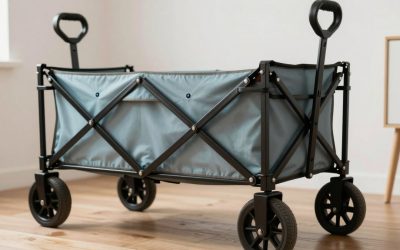
- Folding utility wagon. Good for light items and easy to store, though fabric beds suit pots and tools more than soil.
- Garden dump trailer. Better for large properties with a tractor, as long as hitch weights stay within the manual.
Care and safety
Hose off soil, lime and fertilizer after use, dry steel beds and touch up chips with paint to slow rust. Check axle bolts, cotter pins and tire pressure at the start of the season. Keep loads balanced and low, stay under the stated rating, and avoid steep slopes with heavy cargo. Never let anyone ride on a cart, and when towing keep to the speed and load limits in the tow vehicle and cart manuals. Replace bent side panels instead of straightening them.
Frequently Asked Questions
What is the difference between a utility cart and a dump cart?
A utility cart has a flat or shallow bed for objects and long items, while a dump cart has a tilting tub for loose material. Utility carts need shoveling for soil, and dump carts struggle with long boards. Many gardeners end up using one of each.
What capacity do I need?
Most households are well served by 600 to 800 pounds, because real loads are lower than the rating. Choose 1,000 pounds or more if you haul firewood, stone or timber often. Higher ratings also mean a heavier cart.
Are pneumatic or flat-free tires better?
Pneumatic tires cushion loads and roll over roots more smoothly but can puncture and need air. Flat-free tires need no maintenance but ride firmer. Thorny or debris-heavy yards favor flat-free, while smooth lawns favor pneumatic.
Can I tow a utility cart behind a lawn tractor?
Some can. The maker lists a 2-in-1 handle on its larger Gorilla carts that tows behind a lawn tractor or ATV. Confirm the specific model is towable and follow the tow vehicle manual.
Will a steel cart rust?
Powder coating slows rust, but chips expose bare steel. Rinse and dry the cart after wet or chemical loads, touch up scratches and store it under cover. Poly beds avoid rust entirely.
Can I buy replacement parts for a cart?
For major brands, yes. The maker sells side panels, front and rear panels, hardware kits and other parts for Gorilla carts separately, though some items can be out of stock. Budget brands vary, so ask about parts before you buy.


Write Your Review
No reviews yet. Be the first to share your experience!