

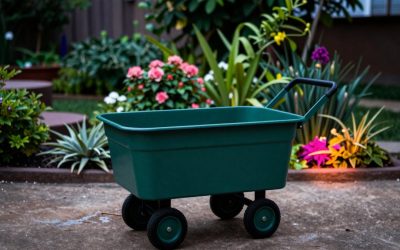
For most homeowners, the Gorilla Carts 4 cubic foot poly dump cart is the usual starting point because reviewers describe a light poly bed, a quick dump mechanism and a 600 pound capacity; larger properties that move soil, rock or firewood are better served by the heavier Gorilla 7 cubic foot no-flat-tire cart, and gardeners who need a lighter, simpler option may prefer a mesh-sided steel cart or the Worx Aerocart. The right cart depends on bed size, tire type and how much weight you move, so this guide walks through those factors and the trade-offs reviewers report.
Our top picks
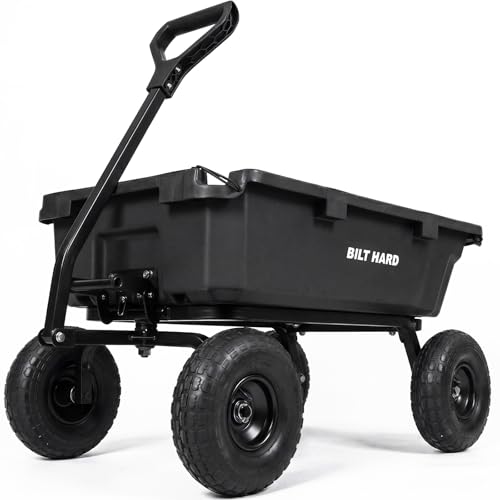 BILT HARD 900 lbs Poly Garden Dump
- All‑Terrain Pneumatic Tires: Equipped with 10‑inch pneumatic tires,…
- Flexible Capacity Expansion: Featuring innovative side expansion slots,…
- Heavy-Duty Construction: Built with a spacious, heavy-duty poly…


As an Amazon Associate we earn from qualifying purchases at no extra cost to you.
Quick Answer: Which Garden Cart for Which Gardener
- Typical suburban yard: a poly dump cart around 4 cubic feet, light enough to maneuver and rustproof.
- Large lots, rock, soil and firewood: a bigger, higher-capacity cart with flat-free tires, such as the Gorilla 7 cubic foot model.
- Mulch, plants and tools with flexible hauling: a steel utility cart with removable sides that works as a flatbed.
- Small yards and light tasks: a compact, lighter cart such as the Worx Aerocart, which reviewers list at 300 lb capacity.
- Very large gardens: a tractor-style cart such as the Polar Trailer utility cart, described in one review as made for regular large-volume hauling.
At a Glance: Popular Garden Carts
| Model | Type | Best for | Reported details | Limits |
|---|---|---|---|---|
| Gorilla Carts GOR4PS Poly Dump Cart | Poly bed dump cart, about 4 cu ft | Most homeowners | Reviewers list a 600 lb capacity and a lightweight bed with a dump system | Pneumatic tires can lose air; poly can crack under abuse |
| Gorilla Carts 7GCG-NF | Heavy-duty dump cart, about 7 cu ft | Large loads and rough use | Reviewers list 1,200 lb capacity, no-flat tires and quick-release dumping | Heavier, reported at over 54 lb |
| Gorilla Carts Steel Utility Cart | Steel cart with removable sides | Mixed hauling, flatbed use | Reviewers list 800 lb capacity | Steel can rust if the finish is chipped |
| Polar Trailer Utility Cart | Large garden cart | Large properties | One review lists capacity of 400 lb or more | Sparse coverage; bulkier to store |
| VEVOR 900 lb steel cart | Steel dump cart | Value-minded heavy-duty buyers | Named a best-value heavy-duty pick by one roundup | Less established support |
| VIVOHOME mesh steel cart | Mesh-sided steel cart | Mulch, leaves, firewood | Reviewers list 880 lb capacity | Mesh can let fine soil fall through |
| Worx Aerocart | Multi-function cart | Small yards, patio use | Listed at 300 lb capacity | Lower capacity than dump carts |
Choosing Cart Size and Capacity
Capacity in pounds and bed volume in cubic feet are separate limits. A 4 cubic foot bed is large enough for several bags of mulch or a few shovels of soil, but a full bed of wet soil or gravel can approach the weight limit well before the bed seems full. Bed volume matters for bulky, lightweight loads such as leaves and branches, while weight rating matters for rock and firewood. If you primarily move yard waste, volume is the priority. If you move stone, concrete or wet soil, look at both numbers and load the cart partially.
Reviewers repeatedly describe the 4 cubic foot Gorilla poly cart as the best value for typical yards. The 7 cubic foot Gorilla is described as the heavy-duty option, and reviewers note its higher price and its weight of over 54 pounds as downsides. A heavier cart is harder to lift into a truck, but it tends to handle repeated heavy loads better.
Bed Material: Poly, Steel or Mesh
Poly (plastic) beds
Poly beds do not rust, wipe clean easily and are light. The 4 cubic foot Gorilla poly cart is the most commonly cited example. The trade-off is that very cold temperatures and sharp loads can stress plastic over time.
Steel beds
Steel carts handle rough loads such as stone and firewood. Look for powder-coated finishes, since chips expose the metal to moisture. Steel utility carts with removable sides, like the Gorilla steel cart, can turn into flatbeds for long items.
Mesh beds
Mesh-sided carts such as the VIVOHOME listing are light and good for bulky items like leaves, brush and firewood. Fine soil and small mulch can fall through, so liners are common.
Tires and Maneuverability
- Pneumatic tires: Air-filled tires absorb bumps and roll easily over grass but can go flat. Keep them inflated to the maker’s pressure.
- No-flat tires: Foam or solid tires avoid punctures. Reviewers call out the Gorilla 7GCG-NF for this feature, with a slightly harder ride.
- Wheel size: Larger wheels roll easier over uneven ground and soft soil.
- Turning: Two-wheel carts tip and dump quickly but need the user to carry some weight. Four-wheel carts distribute weight but are harder to turn in tight beds.
- Handle: A long handle gives leverage. Some carts have a handle that folds flat for storage or converts into a tow bar.
Dump Mechanisms and Storage
A quick-release dump lever lets you tip the bed without lifting, which saves your back. Some carts have a pull-pin or handle-based release, and reviewers praise easy designs. For storage, look for carts that fold, stand upright or have removable sides. A cart left outside year-round should have a rust-resistant finish and, if it has air tires, a place to protect them from sun and cold.
Safety Notes
- Stay within the maker’s stated capacity. Overloading can break axles and make the cart unstable.
- Load heavy items low and near the axle to keep the cart balanced.
- Avoid steep slopes. A loaded cart can run away from you on a hill.
- Wear gloves and sturdy shoes when handling stone, firewood or sharp debris.
- Do not let children ride in a garden cart unless the maker explicitly states it is intended for that.
Budget Tiers
| Tier | Typical choices | Trade-offs |
|---|---|---|
| Budget | Mesh steel carts and compact multi-function carts | Lower capacity or fewer features; thinner finishes |
| Mid-range | Gorilla 4 cubic foot poly cart, VEVOR steel cart, Gorilla steel utility cart | Good value for typical yards; pneumatic tires need care |
| Premium | Gorilla 7 cubic foot no-flat cart, Polar Trailer style carts | Higher capacity and durability; heavier and more expensive |
Pick X If… Decision Table
| Pick this | If you… |
|---|---|
| Gorilla 4 cu ft poly dump cart | have an average yard and move mulch, soil and leaves |
| Gorilla 7GCG-NF | haul rock, firewood or heavy soil often |
| Gorilla steel utility cart | need a flatbed mode and removable sides |
| VEVOR or VIVOHOME steel cart | want large capacity at a lower tier |
| Worx Aerocart | have a small yard and want something compact |
| Polar Trailer style cart | manage a large garden and move volume regularly |
Real-World Use: What Gardeners Haul
A cart earns its keep through the chores it replaces. Spring means bags of mulch, compost and potting mix, which are bulky but moderate in weight and suit a poly bed. Summer brings pots, tools and cut branches, where a mesh or open-sided cart helps with long items. Autumn adds leaves, which are light but fill volume fast, so a bigger bed or a mesh cart with tall sides pays off. Winter often means firewood and snow-covered paths, where tire grip and a sturdy frame matter most. Thinking through the year helps decide whether one larger cart or a smaller cart plus a wheelbarrow is the better plan.
Maintenance is modest but worth doing. Rinse the bed after hauling soil or fertilizer, since residue can stain or corrode. Grease the axle ends once a season if the maker suggests it, and tighten any loose bolts. If a pneumatic tire loses air, top it up to the pressure printed on the sidewall instead of guessing. Stored under cover, a good cart should serve many seasons.
Alternatives
- Wheelbarrow: Better for tight paths and concrete work, though it takes more balance.
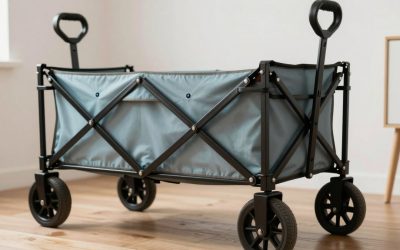
- Folding utility wagon: Useful for light loads, picnics and storage, with lower capacity than dump carts.
- Tow-behind lawn tractor trailer: A suitable choice for large properties that already have a tractor.
Frequently Asked Questions
What size garden cart do I need?
Most homeowners are served by a cart around 3 to 4 cubic feet. Large properties or frequent heavy hauling suit a 7 cubic foot cart. Think about the volume of your usual load, and choose the size you can still lift and maneuver comfortably.
Are no-flat tires worth it?
If you often deal with thorns, gravel or uneven ground, yes. They avoid punctures, though they ride harder. Pneumatic tires are smoother but need pressure checks.
Poly or steel: which lasts longer?
Poly resists rust and is easier to clean, while steel handles rough loads better. Either lasts well with sensible use. Keep steel finishes in good condition to prevent rust.
Can a garden cart tow behind a lawn tractor?
Some can, with a hitch or tow bar, but not all. Read the maker’s instructions. Do not tow a cart beyond the weight rating of the hitch or the tractor.
How do I store a garden cart?
Keep it dry and out of direct sun. Stand it upright if possible and let air-filled tires stay inflated. Some carts fold or have removable sides to save space.
Is a garden cart better than a wheelbarrow?
Carts are usually more stable and easier on the back for heavy or bulky loads. Wheelbarrows are better for tight spaces and fine control. Many gardeners own both.



Write Your Review
No reviews yet. Be the first to share your experience!