

Key takeaways
- Find the best submersible sump pump for utility room drainage, with Wayne, Zoeller and Superior Pump models compared on flow, lift and float type.
A utility room is where a slow leak, a failed water heater, a washing machine overflow or rising groundwater first turns into standing water, and the pump that clears it has to start on its own and move enough water to keep up. Choosing the wrong pump usually means one of two failures: a pump too small to keep up during a heavy inflow, or a pump whose float switch cannot move freely in a narrow pit and never starts. The decision is therefore less about brand loyalty than about matching horsepower, flow at lift, float design and pit size to the room in front of you.
This guide is for homeowners with a utility room pit, a floor drain that backs up, or a laundry and water heater area that collects water after storms or plumbing failures. It also suits anyone replacing a worn pump in an existing pit and wanting a dependable automatic model. Every pump below was chosen from its Amazon product title and listing specifications.
Quick Picks
As an Amazon Associate we earn from qualifying purchases.
| Product | Best for | Key spec from title |
|---|---|---|
| Zoeller M53 Mighty-Mate Submersible Sump Pump | A standard utility room pit that needs a proven cast iron pump | 1/3 HP cast iron submersible sump pump |
| Wayne CDU790 Submersible Sump Pump | A narrow pit where a tethered float would catch on the wall | 1/3 HP, up to 4,600 gallons per hour |
| Wayne CDU980E Submersible Sump Pump | Heavy inflow from a water heater failure or a fast-filling pit | 3/4 HP, 5,490 gallons per hour |
| Superior Pump 92341 Cast Iron Submersible Sump Pump | A deep pit or a long discharge run that needs extra lift | 1/3 HP cast iron, vertical float switch |
| Zoeller M98 Flow-Mate Submersible Sump Pump | A high water table that keeps a pit refilling through a storm | 1/2 HP cast iron, high flow |
How to Choose
Match Flow to Inflow and Lift
A pump rating at zero lift tells you almost nothing about a utility room, because every pump loses flow as it pushes water up a discharge pipe and out of the house. Look instead for the flow at ten feet of lift, which is close to what a typical basement run asks for, and compare that number with how fast water arrives in your pit. A slow-filling pit needs far less flow than one fed by a burst supply line or an emptying water heater tank. Measure the vertical distance from the pump to the discharge point and count the bends in the pipe, treating a long or high run as a reason to step up in horsepower.
Choose the Float Switch for Your Pit
The float switch decides whether the pump starts when it should, and its shape matters more than most buyers expect. A vertical float rides on a rod and needs very little sideways room, so it suits the narrow pits common in utility rooms, where a washing machine drain and a water heater share a tight corner. A tethered float swings on a cord and needs a wider pit, because it can snag on the pit wall, the discharge pipe or the pump cord and stay stuck in the off position. Before buying, measure the inside diameter of your pit and pick the float style that can move through its full travel without touching anything.
Check Construction and Solids Handling
Utility room water is rarely clean, and it often carries lint from a laundry drain, grit from a concrete floor and small debris washed in during a storm. A cast iron housing resists corrosion and stays planted on the pit floor when the motor starts, while a thermoplastic housing is lighter and easier to lift out for cleaning but can shift more under vibration. Solids handling is the other half of the same question: a pump rated for larger solids is less likely to clog on the debris a utility room actually produces. Read the listing for the solids size, the impeller type and the housing material together.
Plan Electrical Safety Before You Install
A sump pump sits in water and runs on mains electricity, so the outlet and the cord deserve the same attention as the pump itself. Plug the pump into a grounded GFCI outlet, and if the utility room outlet is not GFCI protected, have a qualified electrician fit one before the pump goes in. Never handle a plugged-in pump while standing in water, never lift a pump by its power cord, and always unplug it at the outlet before cleaning the pit or clearing the intake. Keep the cord clear of the float switch, route it so it cannot fall into the pit, and test the pump by pouring water into the pit and watching it cycle.
The 5 Best Options
Zoeller M53 Mighty-Mate Submersible Sump Pump
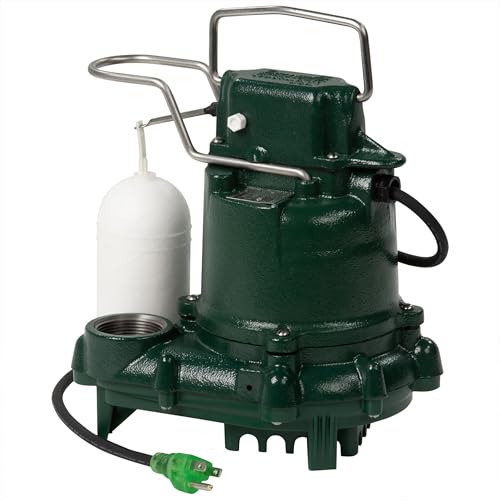
The Zoeller M53 suits a homeowner who wants a straightforward replacement for a standard utility room pit and values a proven cast iron pump. Its 1/3 HP motor covers ordinary seepage, laundry overflows and the steady inflow of a wet season, and its vortex impeller passes the small solids that collect in a utility room pit without clogging as readily as a narrow-impeller design. The pump fits the common 1-1/2 inch discharge size, so it usually drops into an existing installation without new pipe fittings, and its automatic float operation means it starts and stops without anyone watching the pit.
Specs
- 1/3 HP motor, listed as 0.3 HP
- Cast iron construction
- 1-1/2 inch discharge
- Vortex impeller
- Handles solids up to 1/2 inch
- 115 volt operation
- Automatic float operation
Best for: A standard utility room pit with ordinary seepage and a 1-1/2 inch discharge line already in place.
Watch out for: Measure your pit before ordering, because a tethered float needs clear swinging room and can catch on the pit wall in a narrow basin.
Wayne CDU790 Submersible Sump Pump

The Wayne CDU790 is the pick for a narrow pit where space is the limiting factor, because its integrated vertical float switch rises and falls on a rod instead of swinging out to the side. That design lets the pump work in a basin that would trap a tethered float, which is common where a water heater, a laundry tub and a floor drain share one small pit. Its 1/3 HP motor moves up to 4,600 gallons per hour at its maximum rating, giving it more headroom than its horsepower figure alone suggests, and its cast iron and stainless steel construction suits the damp conditions of a utility room floor.
Specs
- 1/3 HP motor
- Cast iron and stainless steel construction
- Integrated vertical float switch
- Up to 4,600 gallons per hour
- 1-1/2 inch NPT discharge
- 3-year warranty
Best for: A narrow utility room pit where a vertical float is the only switch style with room to move freely.
Watch out for: Confirm the discharge connection matches your existing pipe, and check that the vertical float rod has clear travel from its lowest to its highest position.
Wayne CDU980E Submersible Sump Pump

The Wayne CDU980E is for the utility room that faces sudden, heavy water rather than a slow trickle, such as a water heater tank letting go or a supply line break that fills a pit in minutes. Its 3/4 HP motor and 5,490 gallons per hour maximum flow give it the capacity to keep up with a fast inflow that would overwhelm a smaller pump, and its vertical float switch suits a narrow pit as well as a wide one. The cast iron and stainless steel body adds weight and corrosion resistance, which helps the pump stay settled on the pit floor during hard starts.
Specs
- 3/4 HP motor
- Cast iron and stainless steel construction
- Vertical float switch
- 5,490 gallons per hour
- 5-year warranty
Best for: Heavy inflow in a utility room, including a failed water heater or a burst supply line that fills the pit quickly.
Watch out for: Check that your discharge pipe and check valve can handle the higher flow, and confirm the pit is deep enough for the pump and its float travel.
Superior Pump 92341 Cast Iron Submersible Sump Pump
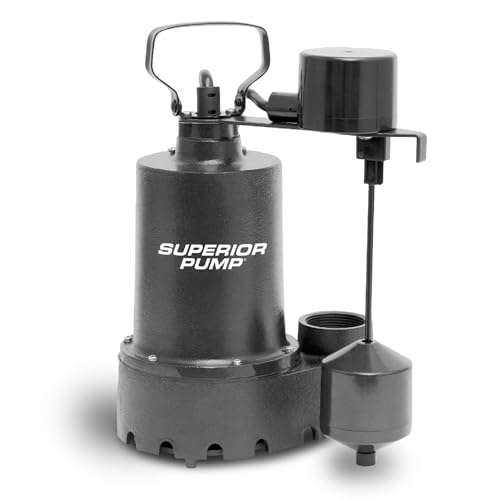
The Superior Pump 92341 fits a utility room where the discharge run is long or high, because its headline strength is lift rather than raw horsepower. It moves up to 2,760 gallons per hour and still delivers 1,800 gallons per hour at ten feet of lift, with a maximum lift of up to 25 feet, so it keeps working on a run that would leave a weaker pump struggling near the top of its range. Its cast iron housing, vertical float switch and 10 foot power cord make it a practical choice for a deep pit, where the outlet sits well above the floor.
Specs
- 1/3 HP motor
- Cast iron construction
- Vertical float switch
- Up to 2,760 gallons per hour
- 1,800 gallons per hour at 10 feet of lift
- Maximum lift up to 25 feet
- 1-1/2 inch discharge
- Handles solids up to 3/8 inch
- 10 foot power cord
- 3-year warranty
Best for: A deep utility room pit or a long, high discharge run where lift matters more than maximum flow.
Watch out for: Check the solids rating against the debris in your pit, and confirm the vertical float has room to travel without catching on the discharge pipe.
Zoeller M98 Flow-Mate Submersible Sump Pump

The Zoeller M98 is the step up for a utility room over a high water table, where the pit refills again and again through a storm and a 1/3 HP pump would cycle almost constantly. Its 1/2 HP motor moves up to 4,320 gallons per hour and delivers 3,660 gallons per hour at ten feet of lift, so it clears a fast-refilling pit with margin to spare. The cast iron body, vortex impeller and snap-action float are built for frequent cycling, and the LED power plug gives a quick visual check that the pump has power, which is useful where an outlet can trip unnoticed behind a water heater.
Specs
- 1/2 HP motor
- Cast iron construction
- Up to 4,320 gallons per hour
- 3,660 gallons per hour at 10 feet of lift
- Snap-action float switch
- LED power plug
- Vortex impeller
- Stainless steel hardware
- 115 volt operation
Best for: A high water table or a pit that refills rapidly during storms and needs a stronger pump that cycles less often.
Watch out for: Confirm the pit is wide and deep enough for a larger, heavier pump, and check the float travel before the first storm rather than during it.
Which One Fits Your Situation
A Small Pit in a Crowded Utility Room
Pick the Wayne CDU790 when the pit is narrow and shares its corner with a water heater and a laundry drain. Its integrated vertical float needs almost no sideways room, so it can cycle in a basin where a tethered float would catch on the wall, and its 1/3 HP motor still moves enough water for ordinary seepage and laundry overflows. Measure the pit diameter and check that the float rod can rise and fall without touching the discharge pipe.
A Pit That Fills Fast After a Plumbing Failure
Pick the Wayne CDU980E when the risk is a sudden inflow, such as a water heater tank emptying or a supply line breaking. Its 3/4 HP motor and 5,490 gallons per hour maximum flow are built for exactly that kind of event, and its vertical float suits the narrow pits common in utility rooms. Before installing it, confirm the discharge line and check valve can carry the higher flow without backing up at the joints.
A Long Discharge Run to the Outside
Pick the Superior Pump 92341 when the water has a long way to climb before it leaves the house. Its 1,800 gallons per hour at ten feet of lift and its maximum lift of up to 25 feet mean it keeps moving water on a high run where a pump rated only at zero lift would fade. Its 10 foot cord helps when the GFCI outlet sits above the pit, and its vertical float fits a deep, narrow basin.
A High Water Table That Keeps Refilling the Pit
Pick the Zoeller M98 when groundwater keeps the pit refilling through a storm and a smaller pump would run without rest. Its 1/2 HP motor and 3,660 gallons per hour at ten feet of lift clear a refilling pit, and its cast iron body and vortex impeller are made for the cycling that a high water table demands. For a standard pit with ordinary inflow, the Zoeller M53 gives the same cast iron build in a smaller package.
Common Mistakes
- Buying on maximum flow alone and ignoring the flow at ten feet of lift, which is the number that decides whether the pump keeps up on a real discharge run.
- Fitting a tethered float switch in a narrow utility room pit, where it can catch on the wall or the discharge pipe and fail to start.
- Plugging a sump pump into an unprotected outlet instead of a grounded GFCI outlet, and handling the pump while standing in water.
- Reusing a worn check valve or a discharge pipe that is too small, so water flows back into the pit and the pump cycles far more than it should.
- Skipping a test run after installation, so the first time the pump is asked to work is during a flood rather than on a dry afternoon.
Frequently Asked Questions
How much horsepower does a utility room sump pump need?
A 1/3 HP pump serves most utility rooms when the inflow is ordinary seepage or a laundry overflow and the lift is modest. Step up to 1/2 HP for a high water table or a fast-refilling pit, and to 3/4 HP for a sudden plumbing failure. Compare flow at ten feet of lift too, because a pump strong at zero lift can fade on a high run.
Can a submersible sump pump handle laundry and water heater water?
Yes, when the pump is rated for the solids and debris that laundry and water heater drainage carry. Lint, grit and small debris are normal in a utility room, so check the solids handling figure on the listing and keep the intake screen clear. A pump with a vortex impeller copes better with that water than a pump built only for clean water.
Why does my sump pump run but the water level barely fall?
The usual causes are a discharge line too high or too long for the pump, a failed check valve, or a blocked intake or discharge pipe. Check the lift against the pump rating, listen for water running back after the pump stops, and inspect the intake screen for lint and grit. If the pump is correctly sized and the line is clear, the inflow may be faster than the pump.
How do I stay safe while checking a sump pump in standing water?
Never touch a plugged-in pump or reach into standing water near it. Unplug the pump at the outlet first, standing on a dry surface. Use a grounded GFCI outlet, keep the cord out of the water, and test the pump by pouring water into the pit from a dry position. If the outlet, cord or pump shows damage, or the breaker trips, leave it unplugged and call a qualified electrician.
More from Amazon
Programs that pair well with the guide above. Offers and eligibility are set by Amazon and may change.
Free shipping on eligible items, Prime Video and more. Eligible new members can start with a free trial.
Start a Prime free trialAudiobooks and podcasts to listen to on the go. Eligible new members can start with a free trial.
Try Audible freeAd-free music streaming. Eligible new subscribers can start with a free trial.
Try Music Unlimited freeA free business account with business pricing and bulk-buying tools for work, shop or home office.
Create a business accountAs an Amazon Associate we earn from qualifying purchases.



Write Your Review
No reviews yet. Be the first to share your experience!