

Key takeaways
- Fabric beds wear first at the seams and corners. Avoid loading sharp tools directly against the fabric.
- Telescoping handles loosen over time. Check the lock buttons every season.
- Rinse sand and salt from the frame and hinges after beach use, then dry the wagon fully before folding to prevent mildew.
- Plastic wheels can crack in extreme cold. Store the wagon indoors in winter.
- Do not exceed the rated capacity, and never use a utility wagon to seat a child unless it has restraints and is rated for it.
The best folding wagon cart for most households is the MacSports Wagon Classic, a steel-frame wagon rated for 150 lb with 8 inch wheels that collapses to about 8 inches thick. If you haul bulky garden loads, the Gorilla Carts 7 cu ft folding wagon offers the most volume, and if children ride along and you need a higher 350 lb rating, the Veer Cruiser is the stronger pick. The right choice depends on what you carry, where you roll it, and how much trunk space you can spare.
Folding wagons look interchangeable in photos, but the numbers behind them differ widely. Bed length ranges from about 30 inches to 37 inches, wheel diameter from 7 inches to 12 inches, and empty weight from 12 pounds to over 30 pounds. Those three variables decide whether a wagon feels effortless on a boat ramp or frustrating on a gravel driveway. This guide compares seven real models by the specifications that matter, then shows how to match a wagon to your situation, what wears out first, and which mistakes to avoid.
Our top picks



As an Amazon Associate we earn from qualifying purchases at no extra cost to you.
Quick comparison of the seven picks
| Pick | Best for | Rated capacity | Empty weight | Bed size (L x W x D) | Wheels |
|---|---|---|---|---|---|
| MacSports Wagon Classic | Best overall | 150 lb | 24.5 lb | 31.5 x 17.5 x 10 in | 8 in rubber |
| Veer Cruiser | Kids and heavy loads | 350 lb | 32.5 lb | 33 x 18 x 12 in | 12 in rear, 8 in front |
| Seina Compact Folding Utility Cart | Lightest, easiest to store | 150 lb | 12.1 lb | 30.5 x 16.5 x 9.5 in | 7 in hard rubber |
| Gorilla Carts 7 cu ft Folding Wagon (GCSW-7P) | Garden and bulky cargo | 150 lb | 21 lb | 36 x 20.5 x 15 in | 7 in solid rubber |
| MacSports All-Terrain Beach Wagon | Sand and soft ground | 150 lb | 22 lb | 32 x 17.5 x 10 in | 10 x 4 in plastic |
| MacSports Double-Decker Wagon | Organized two-level loads | 150 lb | 27 lb | Upper 29.5 x 17.5 x 10 in; lower 37 x 16.5 x 7.5 in | 8 in rubber tread |
| Wonderfold W4 (Original, Elite, Luxe) | Families with up to four children | About 300 lb across two benches | About 50 to 60 lb | Elite interior 30 x 19 x 18 in | 8 to 12 in, by model |
Capacity and size figures come from manufacturer listings and independent roundups such as Bob Vila’s folding wagon guide. Always confirm the rating on the exact version you buy, because manufacturers revise models.
Best overall: MacSports Wagon Classic
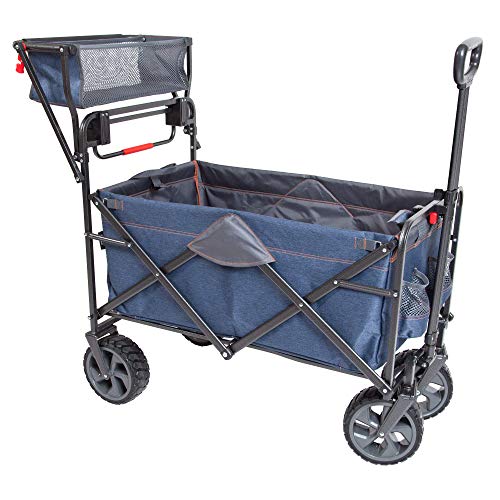
The Wagon Classic earns the top spot because it makes few compromises. It combines a steel frame with a nylon fabric bed, a telescoping handle, and 8 inch rubber wheels, and it ships with a storage cover. The 150 lb rating covers a full grocery run, a cooler and folding chairs, or a stack of soccer gear for a team. At 24.5 pounds it is light enough to lift into a hatchback by yourself.
Who it suits: families, tailgaters, and anyone who wants a single wagon for errands, sports sidelines, and farmers markets. Setup and breakdown take a few seconds, and the folded profile of roughly 8 inches thick slides behind a seat or into a closet.
Pros: simple design, quick setup, included cover, a bed deep enough for most everyday loads. Cons: the wheels struggle on deep sand, and the wagon has no child restraints. If your route includes a beach, look at the all-terrain model below. If kids will ride, look at the Veer Cruiser or Wonderfold.
Best for kids and heavy loads: Veer Cruiser
The Veer Cruiser has the highest rating in this group at 350 lb. It uses an aluminum frame, 12 inch rear wheels and 8 inch front wheels, a three-point harness, cupholders, and a modular design that accepts accessories. It carries a juvenile product safety certification, which matters if you plan to seat a toddler.
Who it suits: parents who want a wagon that doubles as a stroller replacement and still hauls gear. The larger rear wheels roll over curbs, roots, and gravel better than the 7 and 8 inch wheels found on most competitors.
Pros: top capacity, certified safety features, bigger wheels. Cons: it is bulkier when folded and heavier at 32.5 pounds, and the footwell that makes it comfortable for children also reduces flat cargo space. If you only move groceries and garden supplies, you are paying for features you will not use.
Best lightweight compact option: Seina Compact Folding Utility Cart
At 12.1 pounds, the Seina cart weighs roughly half as much as most folding wagons. It keeps a steel frame, a polyester fabric bed, a 150 lb rating, and 7 inch hard rubber tires, and it collapses small enough to share a trunk with luggage. That weight-to-strength ratio is the reason it ranks as the value pick.
Who it suits: apartment dwellers, commuters, and people who carry a wagon up stairs. It is also a practical second wagon for a vacation rental or a boat.
Pros: very light, compact fold, steel frame. Cons: the bed is the smallest here at 30.5 by 16.5 by 9.5 inches, the 7 inch wheels feel every bump on grass, and no storage cover is included, so plan on a bag or sleeve if you stow it with other gear.
Best for garden and bulky cargo: Gorilla Carts 7 cu ft Folding Wagon
This model, sold under the GCSW-7P number, is the volume leader. Its bed measures 36 by 20.5 by 15 inches, and expandable sides, a folding tailgate, and interior zipper pockets make it good for mulch bags, potted plants, firewood, and camping gear. The frame is steel, the bed is heavy-duty sport fabric, and the 7 inch solid rubber tires cannot go flat. It folds to take up about half the storage space of comparable carts.
Who it suits: gardeners, community-plot growers, and campers who haul bulky but not extremely heavy items.
Pros: huge cargo volume, flat-free tires, space-saving fold. Cons: the 150 lb rating is modest for a 7 cubic foot bed, so dense loads such as wet soil or stone can exceed the limit long before the bed is full, and the small wheels dig into soft turf. Note that Gorilla’s separate GCG-7 is a poly dump cart with a 1,200 lb rating and a fixed bed, which is a different product class from this folding wagon.
Best for sand and soft ground: MacSports All-Terrain Beach Wagon
The beach version swaps the standard wheels for 10 inch tall, 4 inch wide plastic wheels and adds an articulating front axle, which keeps the wheels flatter on uneven sand. The bed is 32 by 17.5 by 10 inches, the frame is steel, and the 600D nylon fabric resists UV and mildew. It weighs 22 pounds and folds to about 10 inches thick.
Who it suits: beachgoers, lakeside campers, and anyone crossing a dune boardwalk or a gravel path with a cooler.
Pros: best sand performance in this group, steering that follows uneven ground. Cons: the wide plastic wheels slip on pavement and do not lock, so parking on a slope needs care, and it rolls less quietly than a rubber-wheel wagon on smooth surfaces.
Best for organized loads: MacSports Double-Decker Wagon
The Double-Decker uses two compartments, an upper bed of 29.5 by 17.5 by 10 inches and a lower bed of 37 by 16.5 by 7.5 inches, plus a folding tailgate. Splitting the load keeps heavy items low and fragile items accessible, and the raised upper deck reduces how far you bend. It has 8 inch rubber-tread wheels and a steel frame with nylon fabric.
Who it suits: vendors at craft fairs, teachers hauling supplies, and parents who want snacks separate from sports equipment.
Pros: two-level organization, easier loading height. Cons: at 27 pounds it is heavier than comparable single-bed models, there is no storage cover, and it struggles on sand. It is the right tool only if you will actually use both levels.
Best for families with several children: Wonderfold W4
The Wonderfold W4 line is a stroller wagon rather than a utility wagon, but it belongs in this comparison because many buyers search for folding wagons to carry children. Each of the two benches is rated for about 99 lb, giving roughly 300 lb in total, and the minimum age is 6 months. The Original has 8 inch wheels front and rear, the Elite uses 8 inch front and 9.5 inch rear wheels, and the Luxe steps up to 10 inch front and 12 inch rear wheels. The Elite interior is about 30 by 19 by 18 inches.
Who it suits: families with two to four children who want one vehicle for the park, zoo, and farmers market.
Pros: seat restraints, adjustable canopy, large passenger capacity. Cons: size and weight. Models weigh roughly 50 to 60 lb, and the folded Elite measures about 42 by 29 by 18.5 inches, among the largest folds in the category according to independent measurements. Sedan owners often cannot fit it alongside other cargo.
How to choose a folding wagon: decision matrix
| Your situation | Choose | Why |
|---|---|---|
| Weekly groceries and errands, small car | Seina or MacSports Wagon Classic | Low weight, easy lift, compact fold |
| Garden beds, mulch, potted plants | Gorilla Carts 7 cu ft folding wagon | Deepest bed and expandable sides |
| Beach, dunes, packed gravel | MacSports All-Terrain Beach Wagon | Wide wheels and articulating front axle |
| Toddlers plus gear | Veer Cruiser | Harness, higher rating, bigger rear wheels |
| Three or four children | Wonderfold W4 | Two benches and seat restraints |
| Vendor or classroom loads | MacSports Double-Decker | Two levels keep items sorted |
The numbers that decide fit
Capacity versus real loads
A rated capacity is a static number. Dynamic loads over curbs and bumps stress the frame harder. A practical rule is to keep typical loads at about 60 to 70 percent of the rating, which for a 150 lb wagon means roughly 90 to 105 lb. A cooler with ice and drinks can reach 40 lb, two folding chairs add 15 lb, and a bag of potting soil weighs 25 to 40 lb, so you can reach 100 lb faster than you expect.
Wheel diameter and terrain
Larger and wider wheels lower rolling resistance on soft ground. As a rough guide, a 7 inch wheel stalls at a curb of about 1.5 inches under load, while a 10 to 12 inch wheel handles curbs of 3 inches or more. If your route includes grass, sand, or gravel, prioritize wheel size and width over bed volume.
Fold size and trunk fit
Measure your cargo space before you buy. A wagon that folds to 8 inches thick, like the Wagon Classic, fits behind most rear seats. A wagon that folds to 42 inches long, like the Wonderfold Elite, needs a hatchback or SUV. Compare the folded length and thickness, not just the open bed.
Worked example: push weight
Add the empty weight to the load to see what you actually move. A Veer Cruiser at 32.5 lb carrying 100 lb of gear means 132.5 lb to push, while a Seina at 12.1 lb with the same load means 112.1 lb, about 15 percent less. Over a quarter-mile uphill walk with a cooler, that difference is noticeable, which is why heavier frames only pay off when you need the extra rating or the larger wheels.
Worked example: volume check
The Gorilla wagon bed is 36 x 20.5 x 15 inches, or 11,070 cubic inches, which is about 6.4 cubic feet before the expandable sides are raised. The MacSports Wagon Classic bed is 31.5 x 17.5 x 10 inches, or 5,512 cubic inches, about 3.2 cubic feet. That means the Gorilla holds roughly twice as much, so two bags of mulch that fill a Classic fit comfortably in the Gorilla with room for tools.
Durability and ownership realities
- Fabric beds wear first at the seams and corners. Avoid loading sharp tools directly against the fabric.
- Telescoping handles loosen over time. Check the lock buttons every season.
- Rinse sand and salt from the frame and hinges after beach use, then dry the wagon fully before folding to prevent mildew.
- Plastic wheels can crack in extreme cold. Store the wagon indoors in winter.
- Do not exceed the rated capacity, and never use a utility wagon to seat a child unless it has restraints and is rated for it.
Common mistakes to avoid
The most common mistake is buying on bed volume alone. A big bed with 7 inch wheels is miserable on grass. The second is ignoring the weight of the wagon itself, since a 32 lb wagon plus a 100 lb load is a lot to push uphill. The third is skipping the fold dimensions, which leads to a wagon that lives in the garage and never makes the trip. Finally, many buyers overlook wheel locks, which matter on boat ramps, sidewalks with a slope, and sports sidelines.
Frame, fabric and tire materials explained
Steel frames, used by the MacSports, Gorilla and Seina wagons, are strong and forgiving but add weight and can rust at scratched joints if left wet. Aluminum, used by the Veer Cruiser, resists corrosion and trims weight for a given strength, although dents can bend tubing permanently. For fabric, look for denier ratings such as 600D nylon, which resists UV fading and mildew better than thin polyester. Stitching quality and reinforced corners matter more than the denier number alone.
Tires fall into three groups. Solid rubber never goes flat but transmits more vibration. Hard plastic wheels are light and cheap and perform best on sand when wide, yet they slip on wet pavement. Pneumatic tires cushion best but need pressure checks and can puncture, which is why most folding wagons avoid them. Choose by the surface you cross most often, not by the one you cross once a year.
Loading tips that protect the wagon
- Place the heaviest item low and centered over the axle line so the handle stays light.
- Keep sharp or hard objects away from fabric walls, or wrap them in a towel.
- Pull rather than push on slopes, and lock the wheels when parked if the model has locks.
- Do not stack loads above the side walls without securing them, because a tipped load can bend the frame.
- Unload before folding. Folding a loaded wagon strains the hinges and the cross braces.
When a folding wagon is the wrong tool
If you regularly move loads above 200 lb, such as concrete bags, landscaping stone, or wet firewood, a rigid poly or steel dump cart with pneumatic tires is a better match than a fabric folding wagon. If your path is stairs rather than flat ground, a hand truck or stair-climbing cart will outperform any wagon. A folding wagon is best for light to moderate cargo on mostly flat routes where storage space is the main constraint.
Frequently Asked Questions
What size folding wagon is best for most people?
A bed around 30 to 36 inches long with 8 inch wheels covers most needs. It holds a cooler, chairs, and bags, yet still folds small enough for a standard trunk.
Are folding wagons good for the beach?
They are, if the wheels are wide. Models with 10 inch tall, 4 inch wide wheels and an articulating axle roll across sand far better than standard 7 or 8 inch rubber wheels, which tend to sink.
Can I put a child in a utility folding wagon?
Only if the manufacturer rates it for passengers. Look for harnesses, side supports, and a stated age minimum. Utility wagons without restraints are designed for cargo, so read the product manual first.
How much weight can a folding wagon really carry?
Most rate at 150 lb, with heavier-duty family models reaching 350 lb. Treat the rating as a ceiling and keep everyday loads well below it to protect the frame, fabric, and axles.
How do I clean and store a fabric folding wagon?
Wipe the fabric with mild soap and water, rinse off salt or sand, and let it dry fully open. Fold it only when dry, then store it indoors, ideally in its cover if one is provided.


Write Your Review
No reviews yet. Be the first to share your experience!