

Key takeaways
- Tire material. Foam-filled or solid rubber tires never go flat and need no pump. Air-filled balloon tires run at low pressure and give the softest ride and the least sinking, but they can leak and need an occasional top-up.
- Axle and bearings. Salt air and sand grind into bare steel axles. Wagons that pair stainless or coated hardware with rinsable bearings keep rolling smoothly for more seasons.
The best all terrain beach wagon for most people is a folding model with 10-inch wheels that are at least 4 inches wide, a bed around 30 inches long and a rated load of 150 to 330 pounds. The Mac Sports Heavy Duty All Terrain Wagon is the common all-rounder, the Navatiee 330 lb folding wagon suits soft sand and heavy loads, and the Rangland Sand Warrior RX800 is the rust-resistant pick for people who visit the coast every week. Wheel width and diameter decide how a wagon behaves on sand far more than the load rating printed on the box.
This guide covers beach wagons with big wheels, meaning cart-style wagons built to roll over soft sand, boardwalk gaps, gravel lots and grass. It explains what the numbers on a spec sheet mean, compares six real models, and walks through a simple calculation that shows how much weight you will actually pull on a typical family beach day. Specs below come from manufacturer listings and published product roundups, and manufacturers sometimes revise dimensions between production runs, so confirm the figures against the current spec sheet before you buy.
Quick comparison of the top picks
| Pick | Best for | Wheels | Rated load | Empty weight |
|---|---|---|---|---|
| Mac Sports Heavy Duty All Terrain Wagon | Best overall | About 10 in tall, 4 in wide | 150 lb | About 24.5 lb |
| Navatiee 330 lb Folding Wagon | Soft sand and heavy loads | 9 in balloon-style, front brakes | 330 lb | About 18 lb |
| Rangland Sand Warrior RX800 | Frequent coastal use | 9 in x 4 in balloon wheels | 220 lb | Varies by build |
| Originsure 300L Wagon | Biggest bed for the money | 7 in x 4 in | 560 lb static, about 440 lb dynamic | About 28.4 lb |
| Sekey Heavy Duty Wagon | Bulk gear and coolers | 7 to 9 in all-terrain, by version | See manufacturer sheet | About 27.7 to 29.5 lb on the 48 in model |
| Wonderfold W2 Luxe Stroller Wagon | Beach days with small children | All-terrain XL | 200 lb | About 55 lb |
Rated loads are manufacturer figures. Static ratings, which describe weight sitting in a parked wagon, are usually much higher than the dynamic weight the frame is meant to carry while rolling. When a listing quotes two numbers, plan around the lower one.
Why wheel size beats everything else on sand
Sand is a deformable surface. A narrow wheel sinks until the sand under it is compressed enough to carry the load, then it has to plough forward through the pile that builds up in front of it. A wide wheel spreads the same weight over more area, so it sinks less and ploughs less. A tall wheel climbs out of its own rut more easily because the angle it has to rise is shallower. That is why beach cart guides suggest wheels of at least 10 inches with all-terrain tread, in foam-filled or rubber construction, and why a 6-inch hard plastic wheel can feel fine in the driveway and miserable on the dune path.
Two practical wheel details matter beyond size:
- Tire material. Foam-filled or solid rubber tires never go flat and need no pump. Air-filled balloon tires run at low pressure and give the softest ride and the least sinking, but they can leak and need an occasional top-up.
- Axle and bearings. Salt air and sand grind into bare steel axles. Wagons that pair stainless or coated hardware with rinsable bearings keep rolling smoothly for more seasons.
Best overall: Mac Sports Heavy Duty All Terrain Wagon
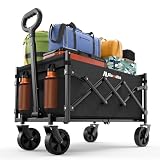
The Mac Sports Heavy Duty All Terrain Wagon is the most widely recommended beach wagon in 2026 roundups, and it earns that position through balance rather than extremes. Published specs list extra-large all-terrain wheels roughly 10 inches tall and 4 inches wide, a 600D polyester fabric bed, a 150 pound capacity and an empty weight near 24.5 pounds (some listings say 22.5). The bed measures about 32 by 17.5 by 10 inches in one published review, and the whole wagon folds to under 10 inches thick so it fits in a hatchback or the back seat of a sedan.
Who it suits: a family of three to five hauling two chairs, a small cooler, an umbrella, towels and toys over packed sand or a boardwalk. It also works for farmers market runs and sports sidelines, so it does not sit unused all winter.
Pros: compact fold, familiar proven design, wide wheels for its class. Cons: reviewers note the wheels can be frustrating on deep, dry, loose sand, and there are no wheel brakes. A version with a side table keeps the same 10-inch wheels and the same 150 pound capacity if you want a built-in serving surface.
Best for soft sand and heavy loads: Navatiee 330 lb Folding Wagon
The Navatiee folding wagon pairs a 330 pound rating with an empty weight of about 18 pounds, which is a favourable ratio for a wagon this size. Its 9-inch inflatable balloon-style tires are the reason it appears in soft-sand recommendations: low-pressure air tires flatten slightly under load and float over sand that would trap a hard wheel. It also has one-touch front wheel brakes, a rare and useful feature when you park on a sloping beach access ramp.
Who it suits: anyone whose beach trip involves a long walk across soft, dry sand, or who carries heavier loads such as a full-size cooler, folding table and two or three chairs.
Pros: light for its capacity, wheel brakes, good flotation. Cons: air tires need occasional inflation and can puncture on shells, glass or thorns, so check them before the first trip of the season and carry a small hand pump in the car.
Best for frequent coastal use: Rangland Sand Warrior RX800
The Rangland Sand Warrior RX800 is built as a dedicated beach cart rather than a general folding wagon. It uses a stainless steel frame, which resists the salt corrosion that eventually eats painted steel, along with 9 by 4 inch balloon wheels and a 220 pound load rating. The wide, low-pressure wheels give it the flotation of a purpose-built sand cart.
Who it suits: people who live near the coast or visit more than a few times a year and want a cart that still looks and rolls well after multiple seasons of salt exposure.
Pros: corrosion-resistant frame, wide balloon wheels. Cons: metal-frame carts generally cost more than fabric-bed folding wagons and offer a less enclosed bed, so loose small items can slide around unless packed in a bag or bin.
Best bed size for the money: Originsure 300L Wagon
The Originsure 300L stands out for volume. The 300 liter bed is large enough for a cooler, a bag of toys and chairs without stacking, and it is rated at 560 pounds static and about 440 pounds dynamic. Its wheels are 7 by 4 inches, which are wide for their height but shorter than the 9 and 10 inch wheels above, and the empty weight is around 28.4 pounds.
Who it suits: large groups and campers who move bulky loads over moderate terrain such as grass, gravel and hard-packed sand.
Pros: huge bed, high ratings, wide tread. Cons: the smaller wheel diameter means it works best on firm surfaces. On very soft sand you may need to keep a steady pace or have a second person lift the front of the handle.
Best for bulk gear: Sekey Heavy Duty Wagon
Sekey sells several sizes of folding wagon, and the heavy-duty versions pair a large bed with all-terrain wheels. Listings quote a 200 liter bed with 9-inch wheels on one version, while the extended 48-inch model offers about 300 liters, 7-inch wheels and an empty weight of roughly 27.7 to 29.5 pounds depending on the source. Capacity figures differ by version and by whether the number is static or dynamic (one source gives 440 pounds dynamic for the 48-inch model, others quote higher), so check the exact model on the spec sheet instead of relying on one headline number.
Who it suits: groups carrying many odds and ends who value bed space and a stable frame over low weight.
Pros: large bed, sturdy frame. Cons: heavier and longer than compact folding models, and the extended version is awkward to fit into a small car trunk.
Best for beach days with small children: Wonderfold W2 Luxe Stroller Wagon
The Wonderfold W2 Luxe is a stroller wagon, not a cargo cart, and is included because many families want a single vehicle for both children and gear. It has all-terrain XL wheels, raised and reclining seats, a removable adjustable canopy and storage space, with a published capacity of about 200 pounds. It weighs roughly 55 pounds empty.
Who it suits: parents who want to carry one or two young children across sand with shade overhead and gear in the rear.
Pros: seating, canopy, big wheels. Cons: heavy, premium-priced, and more than you need if you only plan to haul gear.
A worked calculation: how much will you actually pull?
People tend to guess a beach load and then pick a wagon by its maximum rating. A short calculation gives a more honest answer. Here is a realistic load for a family of four on a full-day trip:
| Item | Typical weight |
|---|---|
| Two folding beach chairs | 14 lb |
| Cooler with ice, drinks and food | 35 to 45 lb |
| Umbrella or pop-up shade with sand anchors | 8 to 15 lb |
| Towels, sunscreen and a change of clothes | 10 lb |
| Toys, shovels and a small bucket of water | 8 to 12 lb |
| Water jug (1 gallon) | 8.3 lb |
| Total | about 83 to 105 lb |
Add the wagon itself, and you are moving around 105 to 130 pounds in total, of which 83 to 105 is payload. That sits under the 150 pound rating of the Mac Sports wagon, but only just if you add a tired child halfway down the path. A 330 pound wagon leaves a comfortable safety margin. The more telling figure is the ratio of rated load to empty weight. A wagon that weighs 18 pounds and handles 330 pounds has a ratio of about 18 to 1, while one that weighs 24.5 pounds and handles 150 pounds has a ratio of about 6 to 1. A higher ratio means the frame has spare strength, which often translates into a more durable wagon.
A second useful calculation is rolling effort. On firm surfaces, rolling resistance is only a few percent of the load, so a 100 pound load needs a few pounds of pull. On soft sand that figure can climb to 10 to 20 percent or more depending on wheel width, so the same 100 pounds can feel like 10 to 20 pounds of constant pull. Wide wheels sit at the low end of that range, narrow ones at the high end. This is why wheel choice matters more than the capacity number.
Decision matrix: match your beach to your wagon
| Your situation | Choose | Why |
|---|---|---|
| Short walk on packed sand, small car | Mac Sports Heavy Duty | Folds compactly and handles moderate loads |
| Long walk over loose, dry sand | Navatiee 330 lb or Rangland Sand Warrior | Balloon-style wide wheels float on sand |
| Weekly coastal use, salt air | Rangland Sand Warrior RX800 | Stainless frame resists corrosion |
| Large group, bulky gear | Originsure 300L or Sekey Heavy Duty | Large bed volume |
| Young children plus gear | Wonderfold W2 Luxe | Seats, canopy and storage |
| Parking on a slope | Navatiee 330 lb | Wheel brakes |
What wears out first and how to extend its life
Most failures on beach wagons come from the same few places, and knowing them helps you spend wisely and maintain what you buy.
- Fabric beds. Polyester fabric holds up well, but seams and corners wear from abrasion with sand, and salt water attacks stitching over time. Rinse the bed with fresh water and let it dry fully before folding so it does not develop mildew.
- Frame joints and hinges. Painted steel frames begin to rust at weld points and rivets. Look for powder coating or stainless hardware, and rinse hinges where sand collects.
- Wheels and axle. Sand packs into hubs. Rinse after each trip, spin the wheel to check for grit, and apply a small amount of silicone or marine-grade lubricant to the axle ends once or twice a season.
- Tires. Air tires should be inflated to the pressure printed on the sidewall and stored out of direct sunlight, which dries and cracks rubber.
- Handles and locking latches. The folding latch is a frequent weak point on cheaper designs. Look for a positive mechanical lock rather than a friction fit.
How to choose: a numbered approach
- Estimate your real load. Use the table above and add 20 percent. That figure should sit below the wagon’s dynamic rating.
- Measure your car. Check the folded dimensions against your trunk. A wagon that does not fit is a wagon that stays home.
- Check the walk. Hard-packed sand and boardwalks suit 7 to 9 inch wheels. Long soft-sand approaches need 9 to 10 inch or larger wheels and a wide tread.
- Consider the handle. A telescoping handle that locks at several heights is easier on tall users, and some models fold the handle flat for storage.
- Think about shade and covers. A cover or canopy keeps the sun off food and children, and a lid helps with sand blowing around.
- Weigh up the empty weight. If you have to lift the wagon into a car or down steps, every extra pound matters.
Common mistakes to avoid
- Buying on capacity alone. A 400 pound rating means little if the wheels sink in the first soft patch.
- Overloading the front. Keep heavy items low and centred over the axle line so the wagon tracks straight and does not tip when a wheel hits a rut.
- Leaving the wagon wet. A damp folded wagon in a hot trunk grows mildew within days.
- Ignoring wheel brakes. On a slope or a windy day, a loaded wagon can roll away. Brakes or a simple chock stone prevent that.
- Pulling too fast in sand. Steady, even pulling beats short bursts because the wheels do not dig in.
Frequently Asked Questions
What size wheels do I need for a beach wagon?
Aim for wheels at least 9 to 10 inches tall and 3 to 4 inches wide for soft sand. Smaller wheels work on hard-packed sand and boardwalks, but they sink and plough on loose sand. Tread and wheel width matter as much as diameter, so a wide 9-inch balloon wheel can outperform a narrow 10-inch one.
Are air-filled or foam wheels better on sand?
Air-filled balloon tires float best on deep sand and ride more softly, but they need occasional inflation and can puncture. Foam-filled or solid rubber wheels are maintenance-free and perform well on packed sand, though they feel stiffer on soft sand. Choose air if you walk long distances on loose sand and foam if you want zero upkeep.
How much weight can a folding beach wagon really hold?
Treat the dynamic rating as the safe working figure. Static ratings describe weight in a parked wagon and are often well above what the frame is intended to carry while rolling. Staying within about 70 percent of the dynamic rating protects the wheels, axle and fabric.
Can I use a beach wagon for things other than the beach?
Yes. A folding wagon with big wheels also handles camping gear, picnics, sports events, garden jobs and farmers markets. The same features that help on sand, such as wide wheels and a flat bed, help on grass, gravel and uneven ground.
How do I clean and store a beach wagon after salt exposure?
Rinse the frame, wheels and fabric with fresh water, wipe hinges and axle ends, then let the wagon dry completely in open air before folding. Store it indoors or under cover, and lubricate moving parts a couple of times each season. Skipping the rinse is the single biggest reason beach wagons corrode early.

Write Your Review
No reviews yet. Be the first to share your experience!