

Key takeaways
- Casters: cheap plastic casters crack under a heavy load. Look for steel ball bearings and a locking brake on at least two wheels.
- Carpet pads: the pad compresses and sheds over time; replacing a worn pad takes minutes with a staple gun.
- Debris: thread, hair and grit wrap around axles and slow wheels. Clean them occasionally.
- Uneven loading: center the weight over the deck. Putting a piece with a heavy back on one side invites a tip.
- Stairs: never ride a flat dolly down stairs; carry the load.
The best furniture dolly for most moves is a set of four-wheel padded movers’ dollies rated for 1,000 pounds or more per set, because carpeted decks protect finishes and a low platform keeps heavy dressers, sofas and bookcases stable. For one-person moves of tall, narrow pieces, add a two-wheel hand truck with a wide nose plate, and for sliding items short distances on hard floors, flat furniture sliders are enough.
Our top picks


As an Amazon Associate we earn from qualifying purchases at no extra cost to you.
Quick Comparison of Furniture Dolly Types
| Pick | Best for | Typical capacity | Deck size | Price tier |
|---|---|---|---|---|
| Padded 4-wheel mover’s dolly | Best overall, dressers, sofas, pianos | 1,000-1,800 lb | 30 x 18 in | Mid |
| Folding furniture dolly (hinged deck) | Best for storage and small cars | 600-1,000 lb | 24 x 14 in | Budget |
| Rubber-wheel convertible hand truck | Best for boxes plus tall furniture | 600-1,000 lb | Nose plate 14 x 7 in | Mid |
| Triangle corner dollies (set of 3-4) | Best for low items, cabinets and planters | 500-1,000 lb per set | 10-12 in per leg | Budget |
| Furniture sliders | Best for rearranging a room | 200-300 lb each | 4-6 in round | Budget |
Best Overall: Padded 4-Wheel Mover’s Dolly
A solid wood or composite deck wrapped in carpet, with four swivel casters of 3 to 4 inches, is the standard movers use for a reason. The carpet grips a dresser base so it does not slide, and the low height of about 5 to 6 inches keeps the center of gravity down. Brands such as Rubbermaid Commercial and Harper Trucks both sell versions in this style.
Who it suits: anyone moving a sofa, a chest of drawers or a full bookcase across a level floor. Main trade-off: it cannot cross a door threshold of more than a half inch easily, and it is not useful on stairs.
Best for Storage: Folding Furniture Dolly
A hinged deck folds in half to roughly 14 inches, so it fits in a closet or trunk. Capacity falls to 600 to 1,000 pounds, which is still more than most furniture needs. The hinge is the weak point: check that it locks flat and does not flex under load.
Best for Mixed Loads: Convertible Hand Truck
Some two-wheel trucks convert to four-wheel platform mode, which makes one tool do both jobs. In upright mode a 14-inch nose plate can slide under a dresser’s side or a boxed bookcase, and rubber wheels protect floors. These trucks suit renters who move boxes and furniture in the same trip.
Main trade-off: in platform mode, the deck is smaller than a dedicated mover’s dolly, so wide sofas can overhang.
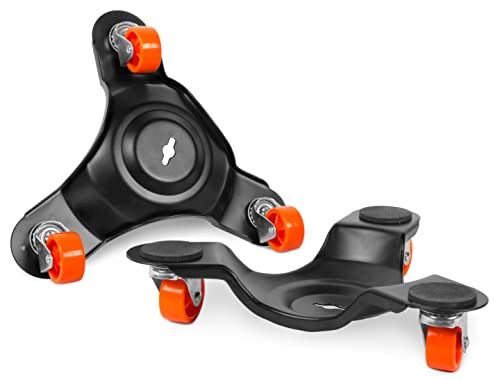
Best for Low or Odd Shapes: Triangle Corner Dollies
Corner dollies sit under each corner of a cabinet, planter or storage chest and let you roll it as a unit. They need a piece that is at least roughly 12 inches deep on each side. Use three or four, and note the combined rating rather than the per-dolly rating, which is the number manufacturers print.
Best for Rearranging: Furniture Sliders
Sliders do not roll; they glide. Hard plastic or felt-bottom versions work on carpet, and soft-bottom versions on hardwood. They cannot cross gaps and are only for short moves, but they cost very little and prevent floor scratches during a room refresh.
How to Choose by Numbers
Add the piece’s weight to the weight of whatever is inside it, then divide by the number of dollies. A drawer-loaded 180 pound dresser on four casters puts 45 pounds on each wheel, well inside a typical 250 pound per-caster rating. Per the manufacturer’s spec sheets, quoted capacities are usually the total for the dolly, so check whether yours is per dolly or per set.
| Furniture piece | Typical weight | Suggested dolly | Notes |
|---|---|---|---|
| Three-seat sofa | 120-200 lb | Padded 4-wheel, two dollies | Remove cushions and legs |
| Dresser, 6 drawer | 150-250 lb | Padded 4-wheel | Empty drawers first |
| Bookcase, 6 ft | 70-120 lb | Convertible hand truck | Move it upright with a strap |
| Upright piano | 300-500 lb | Piano dolly or two padded dollies | Professional help advised |
| Floor planter | 50-150 lb | Triangle corner dollies | Water the plant after |
Ownership Realities and Mistakes
- Casters: cheap plastic casters crack under a heavy load. Look for steel ball bearings and a locking brake on at least two wheels.
- Carpet pads: the pad compresses and sheds over time; replacing a worn pad takes minutes with a staple gun.
- Debris: thread, hair and grit wrap around axles and slow wheels. Clean them occasionally.
- Uneven loading: center the weight over the deck. Putting a piece with a heavy back on one side invites a tip.
- Stairs: never ride a flat dolly down stairs; carry the load.
How to Choose a Furniture Dolly Step by Step
Furniture varies far more than appliances do. A dresser, a sofa, a planter and a bookcase each fail on a dolly in a different way, so the best approach is to decide based on the piece and the route rather than a single headline rating.
- Sort your furniture by shape. Wide and low pieces such as sofas and dressers suit a padded platform. Tall and narrow pieces such as bookcases suit a strapped hand truck. Square or round pieces with a flat base, such as planters and cabinets, suit corner dollies.
- Weigh the heaviest piece with its contents. A full bookcase or a dresser with clothing in it can be double the empty weight. Empty it where you can, but plan the dolly rating around the loaded figure in case you cannot.
- Check whether the rating is per dolly or per set. A set rated for a stated total shares the load across all of its parts. Divide accordingly before you compare two listings.
- Measure the floor route. Note every threshold, rug edge, floor transition and door width. Small casters stall on raised edges, while larger wheels or a convertible truck handle them better.
- Match the wheel material to the floor. Rubber and soft polyurethane protect hardwood, tile and vinyl. Hard plastic is fine on rough concrete but can mark finished surfaces.
- Choose how you will store it. A padded platform needs floor or wall space. A folding model fits in a closet. A set of sliders fits in a drawer. If space is tight, that alone can decide the purchase.
Who Should Skip a Furniture Dolly
A dolly makes sense for plenty of households, but not all of them.
- You live in a small studio and rarely rearrange. If you move furniture once every few years, renting a dolly or borrowing one from a friend costs less and takes up no space.
- Your pieces are delicate or antique. A hand-finished table or a veneered cabinet is better handled with blankets and a trained crew. A platform dolly can scrape or stress joints on an old frame.
- Your home is mostly stairs. Flat platforms are for level floors. If the move is up or down several flights, you need a strapped truck or professional help, not a rolling platform.
- The furniture is extremely heavy. Pianos, safes and large stone-topped pieces exceed what consumer dollies are designed to carry safely. This is work for specialists with the right equipment.
- Your floors are soft or damaged. Loose vinyl, aging cork and thin floating floors can dent or split under concentrated wheel loads. Sliders with felt or soft bases may be gentler in those cases.
Compatibility and Fit Checks Before You Order
A dolly that does not fit the piece it is meant to carry is the most common reason for returns. These checks take a few minutes and prevent most surprises.
Check the base of the furniture
- Legs versus a solid base. A platform dolly needs a flat contact patch. Furniture on legs may need the legs removed, or a second pair of dollies under each end so the frame spans the platforms.
- Recessed bases. Some cabinets have a toe-kick inset that hides the true edge. Measure from the outer corner of the base, not the top.
- Uneven bottoms. A dresser with a center rail may sit unevenly on a single deck. Check that the weight rests on the edges or across the full surface.
Check the dolly deck
- Deck size. The deck should cover most of the footprint of the piece. A sofa that overhangs by more than a few inches can tip.
- Surface grip. Carpeted decks resist sliding. Bare plastic or metal decks may need a rubber mat or a folded blanket.
- Caster quality. Look for sealed bearings, a swivel plate that does not wobble, and locks on at least two wheels.
Check the corner dolly fit
Corner dollies cradle the corner of a piece, so they work best on square or rectangular bases with at least a few inches of flat edge. Round bases, pieces with rounded corners and furniture with feet that flare outward can slip out. Test by lifting one corner and placing the dolly under it before committing.
Floor Protection and Moving Technique
Good technique protects both the furniture and the house. The same dolly can be gentle or destructive depending on how it is used.
- Lift, do not drag. Raise one end of the piece, slide the dolly under, and lower it. Dragging a loaded dresser across a deck scrapes both surfaces.
- Remove what can be removed. Take out drawers, shelves, cushions, glass panels and detachable legs. Weight drops and the piece becomes easier to balance.
- Wrap and pad. Moving blankets protect corners and polished faces. Use stretch wrap to hold doors and drawers closed, but keep it off finished wood, where it can pull at the surface.
- Use a floor runner. A strip of hardboard, plywood or heavy cardboard spreads the load of the wheels and prevents ruts in soft floors.
- Push, do not pull. On flat ground it is easier to steer a loaded dolly by pushing. A helper walking in front can watch for obstacles and open doors.
- Brake before loading or unloading. A dolly that rolls away while you lower a heavy piece is a common cause of pinched fingers.
Furniture sliders work differently. Place one under each corner by tipping the piece slightly, then push slowly. Do not use sliders on pieces that rock, since the loose pad can shoot out. They are for short, careful moves on a clear floor.
Scenario-Based Picks From the Types Above
- Moving a sofa across a single level. Two padded four-wheel movers’ dollies, one under each end, give a stable platform. Take the cushions off first.
- Relocating a heavy dresser to another room. Empty the drawers, lift one side onto a padded dolly, then the other. The carpeted deck holds the base in place, and the low height keeps the dresser steady.
- Moving a boxed bookcase or a tall cabinet. A convertible hand truck in upright mode with a strap does the job. Keep the heavy end low and the load centered.
- Shifting a large planter or a storage chest. Triangle corner dollies let you roll it as one unit. Water the plant after the move, not before, so the weight stays low.
- Refreshing a living room layout on carpet or hardwood. Furniture sliders matched to the floor type are cheap and quick, and they avoid the setup time of a full dolly.
- Living in a small apartment with limited storage. The folding furniture dolly collapses to fit a closet and handles most moves with ease.
- Mixed moving day with boxes and furniture. The convertible hand truck gives the most flexibility, so one tool carries both without a second purchase.
Maintenance, Lifespan and Quick Fixes
Furniture dollies are simple tools with a few predictable wear points. A few minutes of attention extends their life by years.
| Problem | Likely cause | Fix |
|---|---|---|
| Wheels stick or drag | Hair, thread or grit wrapped around the axle | Cut away the debris and wipe the axle clean |
| Dolly wobbles | Loose caster bolts or a cracked swivel plate | Tighten the bolts; replace the caster if the plate is cracked |
| Carpet deck slides under load | Worn or compressed pad | Re-cover the deck with a new piece of carpet or a rubber mat |
| Folding deck flexes | Hinge fatigue or a missing lock pin | Replace the hinge hardware, and stop using the dolly if the deck bends |
| Wheels leave marks on floors | Hard plastic casters | Swap to rubber or polyurethane wheels, or lay down a floor runner |
| Sliders slip off | Worn adhesive or the wrong floor type | Replace the pad and match the base material to the floor |
Store platform dollies flat or hang them on a wall, since leaning them against a surface for months can warp a wood deck. Keep folding models latched in the closed position, and check the lock before each use. For corner dollies and sliders, inspect the pads regularly, because a worn pad can mar the floor it was meant to protect.
A realistic lifespan for a good padded dolly is many years of household use, as long as you do not exceed the rating and keep the casters clean. Cheap plastic casters are the part most likely to fail first, so budget for a replacement set if you plan to move heavy loads often.
More Questions Buyers Ask
Can I use furniture dollies on carpet?
Yes, but small hard casters sink into thick carpet and are hard to push. Larger rubber wheels roll better, and a sheet of hardboard laid over the carpet turns the route into a hard surface. Sliders can also work on carpet when they have a hard plastic base.
How do I keep furniture from sliding off a dolly?
Use a carpeted or rubberized deck, center the weight, and tie the piece down with a strap or stretch wrap if the route is long. Keep your pace slow so the load does not shift when you stop.
Are corner dollies safe for tall pieces?
They are best for low, stable pieces. Tall items raise the center of gravity and can topple when a wheel catches a gap. Use a strapped hand truck for tall furniture instead.
What should I do about a threshold between rooms?
Lay a small ramp or a strip of hardboard across it, or lift one end of the piece over the edge with a helper. Pushing a loaded dolly straight into a raised threshold can stop it suddenly and tip the load.
Do I need blankets if I use a dolly?
Yes, for any piece with a finish worth keeping. A dolly protects your back and the floor, but it does not stop corners from scratching in doorways. Moving blankets and a few clips are inexpensive and worth using on every trip.
Frequently Asked Questions
How many furniture dollies do I need to move a sofa?
Two padded dollies placed under each end are usually enough for a typical sofa, because the weight is spread across all four casters on each deck. For a long sectional piece, use three dollies for better balance.
Can furniture dollies damage hardwood floors?
Hard plastic casters can scratch or dent hardwood under heavy loads. Choose rubber or soft polyurethane wheels, and lay a thin plywood sheet or moving blanket on the route for extra protection.
What is the difference between a furniture dolly and an appliance dolly?
A furniture dolly is a low platform that carries the piece on its base, while an appliance dolly is an upright hand truck with a strap that holds a tall item against the frame. The first is for stability on flat floors; the second is for stairs and thresholds.
Is it worth buying a furniture dolly instead of renting one?
If you move once every few years, renting a dolly for a day is the cheaper route. Owning pays off if you have a basement workshop, a rental property, or move more than twice a year.
How do I move furniture up stairs?
Remove drawers, doors and legs to cut weight, use a strapped hand truck, and keep a helper on the lower end. For heavy pieces that exceed what two people can handle, hire movers.
More from Amazon
Programs that pair well with the guide above. Offers and eligibility are set by Amazon and may change.
Free shipping on eligible items, Prime Video and more. Eligible new members can start with a free trial.
Start a Prime free trialAudiobooks and podcasts to listen to on the go. Eligible new members can start with a free trial.
Try Audible freeAd-free music streaming. Eligible new subscribers can start with a free trial.
Try Music Unlimited freeA free business account with business pricing and bulk-buying tools for work, shop or home office.
Create a business accountAs an Amazon Associate we earn from qualifying purchases.







Write Your Review
No reviews yet. Be the first to share your experience!