

Key takeaways
- Casters: lock them whenever the cart is parked, and replace squeaky ones with rubber wheels.
- Heat: never place a microwave directly against a wall; blocked vents shorten its life.
- Cords: route cords through a cable clip so they do not snag on wheels.
- Cleaning: wipe laminate or sealed wood with a damp cloth; avoid soaking.
- Assembly: tighten screws again after a month, since cart frames loosen with use.
The best microwave cart for most kitchens is a rolling cart 24 to 36 inches wide with a weight-rated top shelf of at least 100 pounds, a locking-caster base, and one or two storage shelves below. Measure your microwave and the ventilation clearance first, since a cart that fits the footprint but blocks airflow is the most common mistake.
Our top picks


As an Amazon Associate we earn from qualifying purchases at no extra cost to you.
Quick Comparison of Microwave Cart Styles
| Pick | Best for | Typical size | Top shelf load | Price tier |
|---|---|---|---|---|
| Rolling 3-tier steel cart | Best overall, small kitchens | 24 x 16 x 34 in | 100-150 lb | Budget to mid |
| Wood-top cart with cabinet | Best for style and hidden storage | 30 x 18 x 36 in | 100-200 lb | Mid |
| Baker’s rack with microwave shelf | Best for storage volume | 36 x 16 x 60 in | 60-100 lb per shelf | Mid |
| Drop-leaf kitchen island cart | Best for prep space | 40 x 20 x 36 in | 150-250 lb | Mid to premium |
| Narrow slim rolling cart | Best for tight gaps | 14 x 18 x 34 in | Not for microwaves; storage only | Budget |
Best Overall: Rolling Steel Cart
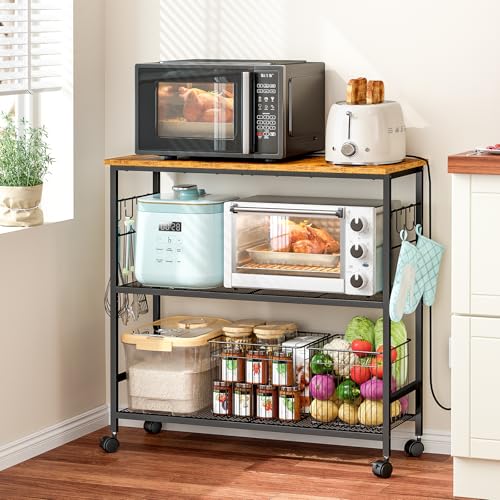
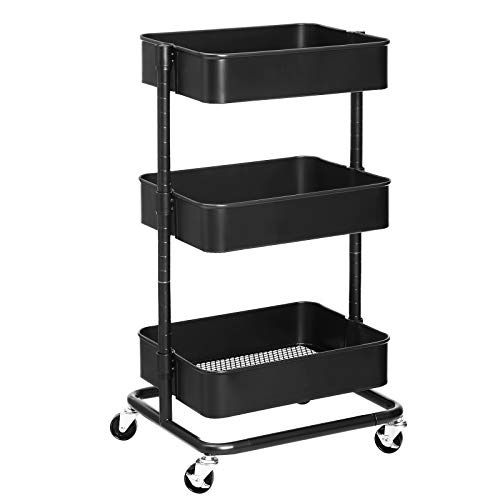
A three-tier steel cart with locking casters offers the best balance of price, footprint and capacity. A typical countertop microwave weighs 25 to 45 pounds, so a 100 pound rated top shelf has a comfortable margin. Add a lower shelf for a toaster or air fryer and a bottom basket for plates.
Main trade-off: bare metal shelves show scratches and can clink, so a liner mat helps.
Best for Style: Wood-Top Cart With Cabinet
A cart with a solid wood or butcher-block top and a closed cabinet below conceals clutter and doubles as extra counter space. Look for a top that is at least 1 inch thick and a back panel cutout for the cord. Cheaper particleboard tops swell if they get wet, so wipe spills promptly.
Best for Storage: Baker’s Rack
A baker’s rack uses vertical space with a microwave shelf at waist height, wine rack or hooks above, and cabinet drawers below. Racks are good if your floor space is small but your wall is tall. Stability depends on how the rack is anchored; secure tall ones to the wall using the supplied bracket.
Best for Prep Space: Drop-Leaf Island Cart
A drop-leaf cart expands from 28 inches to about 40 inches when the leaf is raised, so it works as an extra prep surface. The leaf can sag under heavy loads, so keep the microwave on the fixed top.
Narrow Carts: Storage Only
Slim 14-inch rolling carts are popular in tight gaps but are not wide enough for a typical microwave, which measures 18 to 22 inches wide. Use them for spices, cleaning supplies or pantry items instead.
How to Choose by Numbers
Measure the microwave width, depth and height, then add clearance. Most manufacturers’ installation guides call for about 3 inches on the top and 1 to 2 inches on each side and back for ventilation, so a 20 inch wide microwave needs a shelf at least 22 to 24 inches wide.
| Microwave size | Typical dimensions (W x D x H) | Weight | Minimum shelf |
|---|---|---|---|
| Compact 0.7 cu ft | 17 x 13 x 10 in | 25-30 lb | 20 x 15 in |
| Mid-size 1.1 cu ft | 20 x 16 x 12 in | 30-38 lb | 23 x 18 in |
| Large 1.6 cu ft | 24 x 20 x 14 in | 40-50 lb | 27 x 22 in |
| Microwave and air fryer combined | Varies | Add up both | Check weight rating |
Worked example: a 1.1 cubic foot microwave at 35 pounds, plus a 10 pound shelf organizer, plus a bag of popcorn and a bowl on top at 5 pounds totals 50 pounds, so a cart rated for 100 pounds on the top shelf has a 2x margin.
Ownership Realities
- Casters: lock them whenever the cart is parked, and replace squeaky ones with rubber wheels.
- Heat: never place a microwave directly against a wall; blocked vents shorten its life.
- Cords: route cords through a cable clip so they do not snag on wheels.
- Cleaning: wipe laminate or sealed wood with a damp cloth; avoid soaking.
- Assembly: tighten screws again after a month, since cart frames loosen with use.
How to Choose a Microwave Cart Step by Step
A microwave cart is a small purchase that affects how the whole kitchen works. A few measurements and honest answers about how you cook will point to the right style quickly.
- Decide what the cart must do. Is it only a stand for the microwave, or does it also need to hold a coffee station, an air fryer, a toaster and a drawer of utensils? A cart that is asked to do too much ends up overloaded.
- Measure the microwave with its door open. The door swing needs clear space, and a cart placed too close to a wall or cabinet may stop the door from opening fully.
- Check the vent locations. Some microwaves vent from the back, some from the top or sides. The shelf must leave those spots uncovered, according to the installation guide.
- Measure the floor spot. Include room to walk past, to open nearby cabinets and to roll the cart out for cleaning.
- Pick the height by the user. The microwave should sit near elbow height for adults, so hot food is not lifted overhead. For children or seated users, a lower shelf is safer.
- Choose the material to suit the room. Steel suits a modern or utility look, wood-top carts suit a warmer kitchen, and baker’s racks suit rooms with limited floor space.
Who Should Skip a Microwave Cart
- You have a built-in or over-range microwave. Those models are meant to be installed in a cabinet or hood, and a cart adds nothing.
- Your kitchen is too narrow for a rolling piece. If a cart would block a walkway or an appliance door, a wall shelf or a bracket mount is a better choice.
- You have a toddler or a crawling baby. A tall baker’s rack or a cart at floor level is a hazard. A securely mounted shelf out of reach is safer.
- Your floor is uneven. Tiles with deep grout lines, or older floors with a pronounced slope, make a rolling cart wobble, even with locked wheels.
- You need heavy-duty counter space. A light cart is not a substitute for a real work surface. If you chop, knead or roll dough daily, a fixed island or table is a better foundation.
Placement, Safety and Ventilation Checks
A cart changes the way a microwave sits in the kitchen, so a few safety checks are worth doing before the first use.
Power and cord safety
- Plug the microwave directly into a wall outlet. Extension cords and power strips are not designed for the load a microwave draws.
- Keep the outlet within easy reach of the cart’s final spot, so the cord stays short and off the floor.
- Route the cord along the cart frame with clips. A loose cord can snag on a wheel when the cart is moved.
Airflow and heat
- Leave the clearances described in the installation guide on the top, sides and back.
- Do not stack items on top of the microwave. Anything that blocks the vents traps heat.
- Avoid placing the cart next to a stove or oven, where radiant heat can warm the shelf and the microwave housing.
Stability
- Lock the casters whenever the cart is in use. Opening a microwave door and pushing buttons creates small forces that can nudge an unlocked cart.
- Place the heaviest items on the lower shelves, and keep the top shelf for the microwave alone.
- Test the cart by pushing gently on the top corner. It should not rock or slide.
Scenario-Based Picks From the Styles Above
- A small apartment kitchen with no counter room. The rolling three-tier steel cart gives the microwave a home and adds shelves for a toaster or a bin of snacks, all in a compact footprint.
- A dining area where the cart is on show. The wood-top cart with a cabinet hides clutter and blends with other furniture.
- A tall kitchen with little floor space. The baker’s rack uses vertical room for storage, with the microwave at waist height. Anchor it to the wall.
- A household that cooks and bakes often. The drop-leaf island cart provides extra prep space on demand, folding away between uses.
- A narrow gap beside the fridge. A slim rolling cart is not a microwave stand, but it does well for spices, cleaning products and canned goods.
- A coffee corner. A rolling cart with hooks and a middle shelf keeps mugs, a machine and a kettle together, with the microwave on the top shelf.
| Priority | Best style | Watch out for |
|---|---|---|
| Compact footprint | Rolling steel cart | Shelf clinking and scratches without liners |
| Looks and hidden storage | Wood-top cart with cabinet | Moisture damage to particleboard |
| Maximum storage | Baker’s rack | Tall frame needs a wall anchor |
| Prep surface | Drop-leaf island | Leaf sag under heavy loads |
| Tight gap | Slim rolling cart | Too narrow for a microwave |
Assembly, Maintenance and Lifespan
Most carts arrive flat-packed, and how well you assemble one often decides how long it lasts.
Assembly tips
- Lay out every part and check the count against the instructions before you start.
- Hand-tighten all the screws first, then do a final tightening once the frame is standing. Fully tightening too early can misalign holes.
- Check that the frame is square by measuring the diagonals. If the two measurements differ, loosen the screws and adjust.
- Attach the casters firmly, and make sure the brakes engage on at least two wheels.
Ongoing care
- Re-tighten screws after the first month and then every few months. Frames loosen slowly as the cart rolls and loads change.
- Wipe steel and laminate surfaces with a damp cloth and a mild cleaner. Dry them to prevent water spots and rust at the joints.
- Seal exposed wood tops with a food-safe finish if the cart sees spills, and renew it from time to time.
- Lubricate squeaky casters with a drop of light oil, and clear any hair and dust from the wheels.
- Do not exceed the shelf rating. Overloaded shelves bow, and bowed shelves rarely recover.
A sturdy steel cart with good welds or well-seated fasteners can last for many years. Wood-top and particleboard carts may show wear faster in kitchens with a lot of steam or spills. When a shelf starts to sag or a caster fails, a replacement part often costs less than a new cart, so check whether the maker sells spares before you give up.
Organizing the Cart So It Stays Useful
A cart that starts tidy often turns into a pile within weeks. A little structure keeps it working.
- Give each shelf one purpose. The top shelf is for the microwave only. The middle shelf holds items you reach for daily, such as a toaster, a kettle or a bread box. The bottom shelf stores heavier, less-used things like a mixer or a stack of serving bowls.
- Use the hooks and sides. Side hooks suit oven mitts, measuring cups and a small towel. Keep them light, since hooks pull on the frame unevenly when overloaded.
- Add small bins. Open baskets prevent loose packets and snacks from sliding off a metal shelf, and they make it easy to pull everything out for cleaning.
- Keep microwave-safe cookware nearby. A lidded glass dish, a splatter cover and a plate rest on the shelf beneath are all the tools most people need.
- Do a monthly reset. Remove everything, wipe each shelf, check the screws and put back only what you use. This keeps weight down and the cart stable.
If the cart feels crowded even after a reset, the problem is usually the number of appliances rather than the cart. Move the least-used one to a cabinet, and the whole setup becomes easier to use and clean.
Choosing Between Locking Casters and Fixed Feet
Most buyers expect wheels, but not every kitchen needs them. Locking casters let you pull the cart out to clean behind it or to use it as a serving trolley at meals. Fixed feet, or a cart with only two casters and two rigid legs, are more stable for a heavy microwave that never moves. If you rarely move the cart, rigid feet remove the risk of a rolling shelf and the squeak of aging wheels. If you want flexibility, choose casters with a lever-style lock on at least two wheels, and press down on each lock after every move. Rubber-tread casters are quieter and kinder to hard floors than hard plastic ones.
More Questions Buyers Ask
Can I put an air fryer on the same shelf as a microwave?
Not on the same level in most cases, since both need clearance for heat and airflow. Place the air fryer on a separate shelf with open space around it, and make sure the cart’s rating covers the combined weight.
Is a metal cart safe with a microwave?
Yes. The microwave energy stays inside the oven cavity, so a metal shelf underneath is not a hazard. The main concern is airflow and weight, not the material.
How do I stop dishes rattling on a steel shelf?
Use a rubber or cork liner mat under plates and bowls. Liners also protect the metal from scratches and stop small items from sliding when you move the cart.
What should I do if the cart leans or wobbles?
Check that the floor is level, tighten all the screws and make sure all four casters touch the ground. A thin shim under a short caster, or a swap to adjustable feet, often fixes the problem.
Can I use a microwave cart outdoors or in a garage?
Only with care. Steel carts rust in damp conditions, and wood tops swell. A covered, dry garage is acceptable. A cart left in rain or humidity will deteriorate quickly.
Frequently Asked Questions
What size microwave cart do I need?
Choose a cart whose shelf is at least 2 to 3 inches wider and deeper than your microwave. A 24 inch wide cart suits most mid-size models.
How much weight can a microwave cart hold?
Most carts rate the top shelf for 100 to 150 pounds, which is enough for a microwave and small appliances. Check the manufacturer’s spec sheet, because the total for the whole cart is not the same as the per-shelf rating.
Can I put a microwave on a wooden cart?
Yes, as long as the shelf is sturdy and the vents have room to breathe. Use a heat-safe mat if the surface is untreated wood.
Do microwave carts need to be anchored?
Short rolling carts do not, but tall baker’s racks should be bolted to the wall, particularly in homes with children. Always lock the casters.
Is it safe to run a microwave on a rolling cart?
Yes, if the casters are locked and the cart is stable. Vibration is minimal, but a wobbly cart can slide a heavy microwave.
More from Amazon
Programs that pair well with the guide above. Offers and eligibility are set by Amazon and may change.
Free shipping on eligible items, Prime Video and more. Eligible new members can start with a free trial.
Start a Prime free trialAudiobooks and podcasts to listen to on the go. Eligible new members can start with a free trial.
Try Audible freeAd-free music streaming. Eligible new subscribers can start with a free trial.
Try Music Unlimited freeA free business account with business pricing and bulk-buying tools for work, shop or home office.
Create a business accountAs an Amazon Associate we earn from qualifying purchases.





Write Your Review
No reviews yet. Be the first to share your experience!